
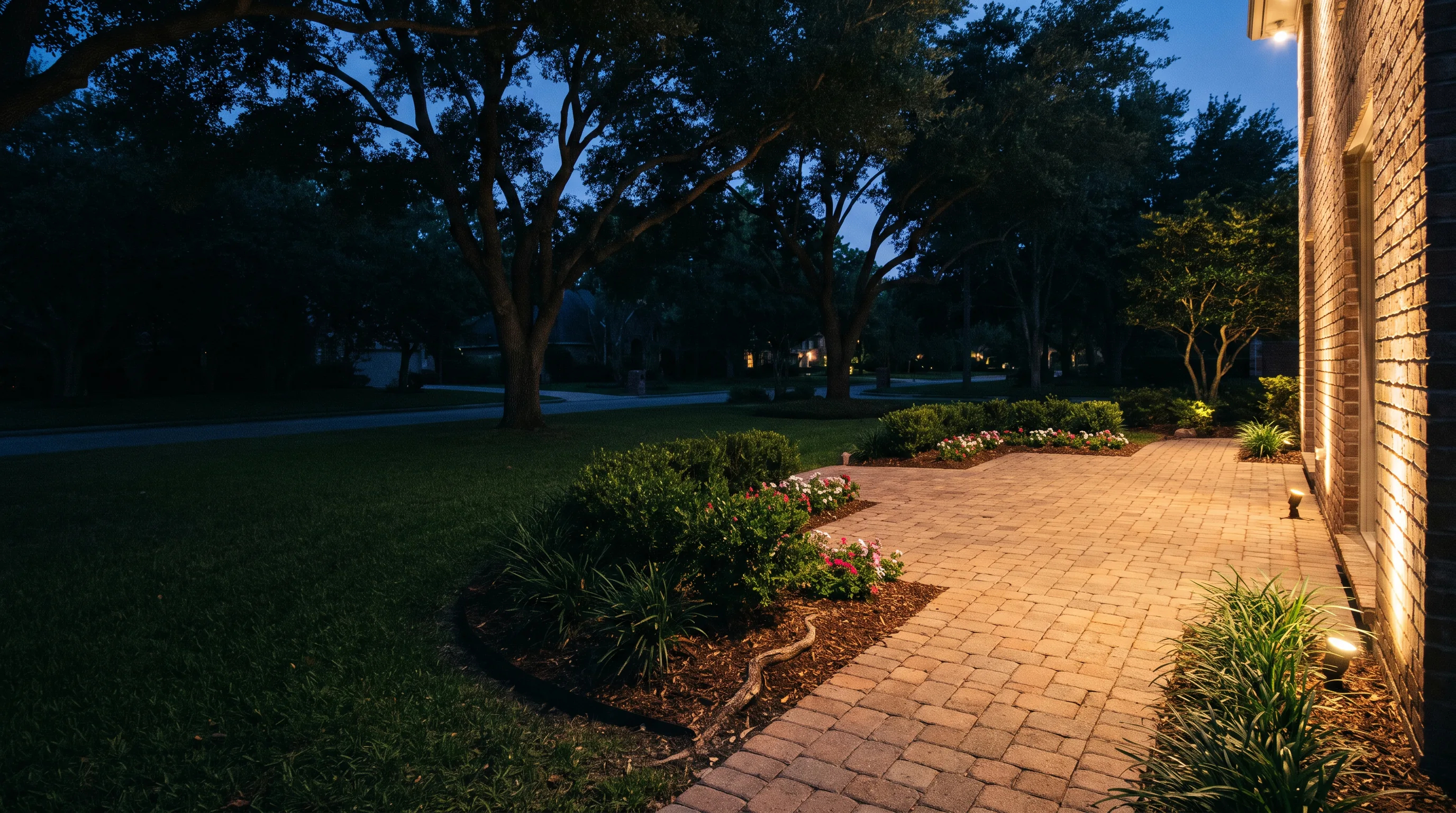
Spring, TX
Landscaping for Harris County clay, and the HOA that reviews it
Design-build landscaping across Klein, Champions, Gleannloch Farms, Augusta Pines and every Spring neighbourhood — drainage engineered for clay, designs drawn for HOA approval.
Standing water is the defining landscaping problem in Spring. Harris County clay absorbs almost nothing, most subdivision lots were graded flat by the builder, and the result is water sitting on the lawn for days and against the slab after every storm. Any scheme here starts with grade and drainage, because planting and hardscape built over an unresolved water problem fail within two seasons. Drainage solutions run $3,000 to $12,000; most whole-property schemes land at $15,000 to $35,000.
Below: what each scope costs in Spring, how to fix standing water properly, which plants hold up in clay and heat, and how HOA approval works in the master-planned communities here.
What we build
What we build in Spring
Design-build across the full range, sequenced so drainage is resolved before anything is built on top of it.

Drainage and French drains
French drains, catch basins, channel drains and regrading to a defined discharge. The first phase on most Spring properties, and often the only one needed.

Landscape design
Surveyed and drawn to scale, in the format your HOA expects. Design is included where we install.

Hardscape and patios
Paver terraces and walkways on compacted bases, jointed for the movement clay actually applies and isolated from the house slab.
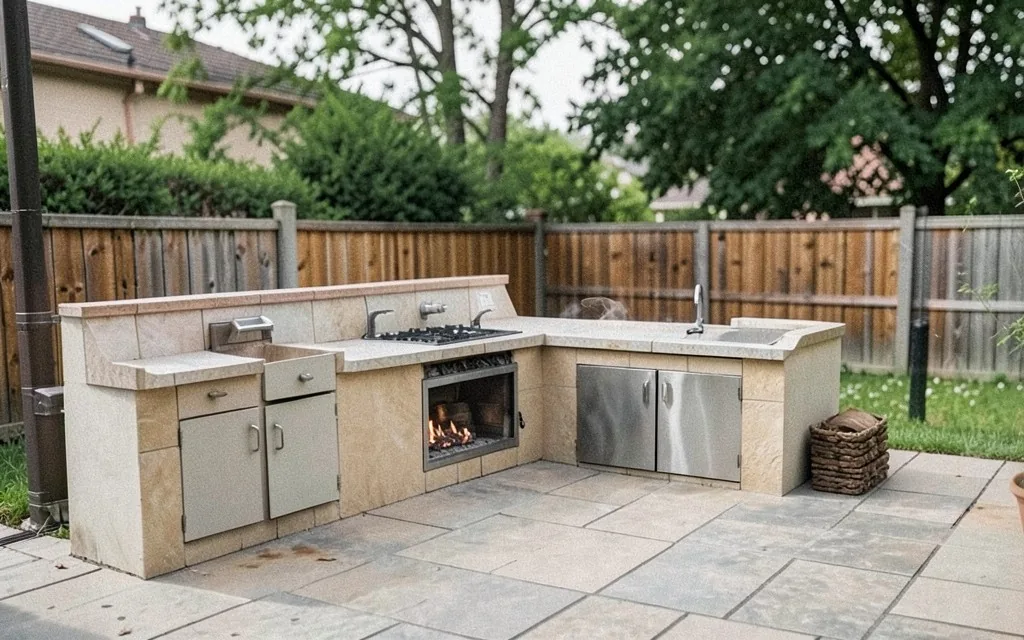
Outdoor kitchens and water
Kitchens, fire features and water features designed into the terrace, with gas, power and water trenched while the ground is open.

Irrigation and sod
Systems zoned to the planting and turf laid on prepared soil rather than onto compacted clay — the two things that decide whether a new lawn survives here.

Landscape lighting
Low-voltage lighting designed with the planting, conduit installed during construction instead of cut into finished paving a year later.
Local conditions
How do I fix standing water in my Spring yard?
Four causes, in the order they should be checked. Three of them are grade, not hardware.
The lot has no fall at all
CauseBuilder grading that left the lawn essentially flat, or settlement since. On clay that absorbs nothing, flat means water sits wherever it lands until it evaporates.
FixLevels surveyed and the grade rebuilt to a one to two percent fall to a defined discharge. Regrading solves more Spring drainage problems than drains do, and it is usually cheaper.
Downspouts discharging at the slab
CauseGutters dropping the entire roof area within a foot of the foundation. It is the largest single volume of water arriving on the property, landing in the worst possible place.
FixDownspouts piped underground to a discharge point or a sized dry well. Frequently the cheapest single improvement available and sometimes the only one required.
The soil is compacted solid
CauseConstruction equipment over clay during the build. The surface is compressed to a state water cannot enter and roots cannot penetrate, so the whole lawn holds water rather than one dip.
FixThe compacted layer ripped and organic matter incorporated alongside the grading. Drains alone will not fix a lot where the entire surface has been sealed.
New turf thins out in the same spots each year
CauseSod laid straight onto compacted clay without breaking the layer beneath it. The roots cannot penetrate, so the turf sits as a mat, dries out fast in July and thins wherever the sun is hardest — the same patches, every summer.
FixThe top four inches tilled to relieve compaction and compost incorporated before any turf is laid, with the grade corrected at the same time. Installing sod is the cheapest moment there will ever be to fix both, because the ground is already open.
Drainage installed with nowhere to go
CauseA French drain that collects water and delivers it a few feet away, because no discharge point was identified before it went in. The puddle moves; it does not leave.
FixThe legal discharge established first — street, easement, ditch or a dry well sized for the volume. Everything else is designed backwards from that point.
Specification
Neighbourhoods we work in
Different eras of construction, different problems. What we find is fairly predictable by neighbourhood.
Klein and Champions
Established neighbourhoods with mature trees and settled grades. Drainage correction, hardscape renewal and shade planting are the recurring work, and root plates constrain terrace edges.
Gleannloch Farms
Master-planned with active architectural review. Designs are drawn for approval from the start, and the review window is built into the schedule rather than discovered.
Augusta Pines and Spring Trails
Newer construction where builder grading commonly falls the wrong way. Regrading and drainage before planting is the usual first phase.
Northgate Crossing and Windrose
Family subdivisions with tight lots. Getting a usable outdoor room and a working discharge point into the same rear garden is the design problem.
Legends Ranch and Cypresswood
A mix of ages and lot sizes. Irrigation zoning and coverage faults are the most common inherited problem on the properties we take over.
Spring Creek Oaks
Larger established lots with mature canopy. Shade planting, lighting into the trees and drainage across a bigger area are the usual scope.

How it runs
Assess, design, approve, build
Drainage assessment happens on the first visit here. It shapes everything that follows.
- 01
Free on-site assessment
Grade measured, drainage patterns recorded, soil compaction checked and the discharge options identified before anything is drawn.
- 02
Design and drawings
Concept and rendered scheme from the viewpoints you use, with drainage and grading already resolved on the plan.
- 03
HOA submission
Drawings prepared in the format your community requires and submitted, with the review period built into the programme.
- 04
Grade and drain
Levels corrected, compaction broken, drainage installed and flow-tested before backfill. The layer everything else sits on.
- 05
Build and plant
Hardscape, sleeves and conduit, irrigation, planting, turf and lighting — in the order that means no finished surface gets reopened.
- 06
Hand over and follow up
Controller programmed for the season, establishment watering explained, and a follow-up visit while problems are still cheap to fix.
What it costs
What does landscaping cost in Spring TX?
2026 ranges for Spring properties. Every property is different; these are the bands most projects fall into.
Basic landscape installation $5,000 – $8,000
Front yard improvements — new beds, shrubs, seasonal colour, mulch and basic irrigation adjustment. Two to four days.
Mid-range with hardscaping $15,000 – $35,000
Paver patio or walkway, new planting, irrigation, lighting and a French drain where needed, including full scaled design. Two to four weeks.
Complete backyard transformation $40,000 – $100,000+
Outdoor kitchen, fire pit or fireplace, extensive hardscape, water features, professional lighting and comprehensive planting. Four to eight weeks.
French drain and drainage solution $3,000 – $12,000
Depending on linear footage, number of catch basins and complexity. Essential on Spring clay. Usually one to three days.
Recent work
Recent Spring projects

Gleannloch Farms
Front yard redesigned around the arrival sequence, HOA approved on first submission, lighting conduit trenched during the build.

Augusta Pines
A lawn holding water for days after rain, corrected by regrading and a French drain to a street discharge, then paved.

Klein
Established lot with a terrace routed clear of mature root plates and shade planting under the canopy.
Why homeowners choose us
Why Spring homeowners use us
- 01
Drainage assessed on the first visit
On Spring clay, water is the problem behind most others. We measure the fall before designing anything.
- 02
The discharge point comes first
A drain with nowhere to go relocates the puddle. We identify the outlet before specifying components.
- 03
HOA-compliant from the start
Community requirements read before designing, and submissions produced in the format the reviewing body expects.
- 04
Clay-tested planting
Species chosen for Harris County clay and zone 9a heat, planted into improved soil rather than a hole in the clay.
- 05
One contractor, one number
Design, drainage, hardscape, irrigation, planting and lighting under one accountable team.
- 06
Warranty on request
On the work we install, which makes base preparation and installation quality our problem rather than yours.
Questions
Landscaping in Spring TX — frequently asked
How much does landscaping cost in Spring TX?
Basic landscape installation for front yard improvements runs $5,000 to $8,000. A mid-range project with a paver patio, planting, irrigation and lighting is $15,000 to $35,000, including full scaled design. A complete backyard transformation with an outdoor kitchen, extensive hardscape and water features runs $40,000 to $100,000 and up. Drainage solutions are $3,000 to $12,000 depending on footage and complexity.
How do I fix standing water in my Spring TX yard?
Start with the grade, not the hardware. Most Spring lots were graded flat by the builder, and Harris County clay absorbs almost nothing, so water sits where it lands. Correcting the fall to one or two percent toward a defined discharge point solves a great many cases on its own. Then pipe the downspouts underground — they deliver the largest single volume of water, usually right at the slab. French drains and catch basins come after that, not instead of it.
What drainage solutions work best for Spring TX clay soil?
Conveyance, not absorption. Clay has a very low infiltration rate, so anything relying on water soaking away underperforms here. Surface solutions — regrading, swales, catch basins and channel drains — move water that is sitting on top of the ground, which is most standing water in Spring. French drains handle soil that stays saturated. The constraint is always where the water can legally go, and on a landlocked lot that means a properly sized dry well.
Do you handle HOA approvals for Spring TX neighborhoods?
Yes, as part of the project. Gleannloch Farms, Augusta Pines, Spring Trails and the other master-planned communities here each have their own architectural review requirements and drawing formats. We read the community documents before designing, prepare the submission in the format expected, and build the review period into the schedule. A submission that is right first time avoids a revision cycle that can cost a planting season.
What plants grow best in Spring TX landscapes?
Species that tolerate heavy clay, zone 9a summer heat and a wet spring. Live oak, dwarf yaupon holly, loropetalum, Texas sage, gulf muhly and other ornamental grasses, lantana, esperanza and knockout roses all perform reliably in sun. For shaded areas under mature canopy, azaleas, camellias, cast iron plant and holly fern hold up well. The real work is matching each plant to the light and drainage of its specific bed.
How long does a landscaping project take in Spring TX?
Design takes three to six weeks, plus the HOA review period where one applies. Construction depends on scope: basic front yard work is two to four days, a mid-range scheme with hardscape and irrigation two to four weeks, and a full backyard transformation four to eight weeks. Wet weather is the main variable — saturated clay cannot be graded or compacted, so a wet spell stops earthwork completely.
Do you offer landscape maintenance after installation in Spring TX?
Yes. We run weekly and bi-weekly maintenance routes with dedicated crews, so the same team services the property each visit. After an installation it works particularly well, because the crew already knows what was planted, where the irrigation runs and what the beds should look like. Establishment care in the first year is where new planting is won or lost.
What neighborhoods do you serve in Spring TX?
Klein, Champions, Gleannloch Farms, Spring Trails, Northgate Crossing, Windrose, Augusta Pines, Legends Ranch, Cypresswood, Spring Creek Oaks and the surrounding Spring area. What we find varies fairly predictably by neighbourhood — newer master-planned communities usually need grade correction, older established ones usually need drainage renewal and shade planting around mature trees.
Can you fix a yard that slopes towards the house?
Yes, and on a Spring lot it is the most worthwhile work you can buy. We survey the levels, import fill where needed, and rebuild the grade to fall away from the slab to a point where water can actually leave. Beyond the standing water itself, it reduces the soil moisture cycling that stresses foundations on expansive clay — which is the more expensive problem sitting behind the visible one.
When is the best time to landscape in Spring TX?
Autumn through early spring for planting — October to March is the strongest window, because roots establish while temperatures are moderate and before the next summer. Hardscape, drainage and grading can be done year-round in principle, but saturated clay stops earthwork completely, so wet spells push those. Summer planting works with attentive watering and costs more in establishment care, and we will say so rather than book it quietly.
Is Boone’s Landscaping licensed and insured in Spring TX?
We stand behind our workmanship — if our installation is the reason something failed, we fix it. Damage, weather and neglect are not covered, and we will price separate cover or a maintenance plan if you want that. Everything is written into the quote rather than agreed afterwards. Documentation is provided with the quote rather than on request. Most HOA architectural review packages in Spring will want contractor details as part of the submission, so having it in order is a practical requirement here rather than just a reassurance.
Why do Spring lawns thin out along fence lines?
It is almost always shade plus root competition rather than a soil problem. Fence lines here usually carry a row of mature trees on one side, and St. Augustine tolerates shade better than most warm-season turf but still needs four hours of direct sun. Where it cannot get that, a shade-tolerant ground cover or a mulched bed outperforms turf that will thin again every year.
Where we work
Serving Spring and North Houston
Spring is a core service area, and we work throughout Montgomery County and into North Houston. Flat lots on Harris County clay are the local condition, and they make drainage the first conversation.
Often specified alongside: French drains and drainage, landscape design, hardscaping and patios, sod installation, irrigation installation, landscape lighting.

Start here
Book a Spring site visit
We come out within 48 hours, measure the actual fall across the lot, find where water can go, and tell you whether you need drainage or just a corrected grade.