
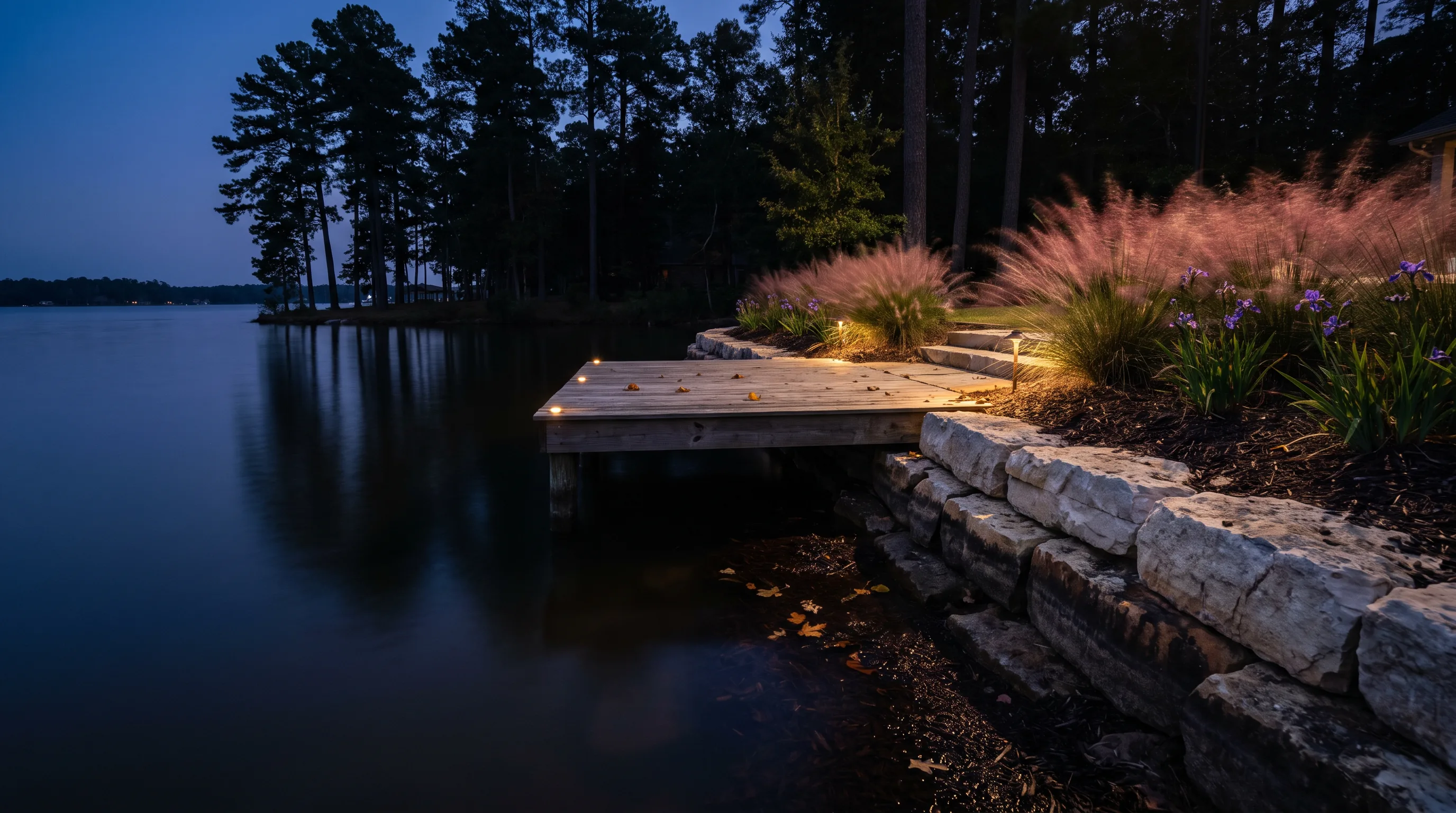
Conroe, TX
Two soils, one county line, and a town growing fast
Design-build landscaping across Conroe — Grand Central Park to April Sound, Walden and Bentwater — with engineered retaining walls, erosion control and drainage for rolling terrain.
The single most useful thing to know about Conroe is that its soil changes across the town — sandy nearer the lake, clay-heavy inland, and sometimes both on one property. A plant list that performs beautifully in Grand Central Park can sulk two miles away for reasons that never get diagnosed. Add rolling terrain that flat-suburb contractors are not set up for, and local knowledge stops being a slogan. Most comprehensive schemes here land at $12,000 to $40,000.
Below: what each scope costs in Conroe, why plant selection has to be made bed by bed here, what a brand-new master-planned lot needs first, and how the local review boards operate.
What we build
What we build in Conroe
Slope and water are the two constants. Most Conroe scopes start with one of them.
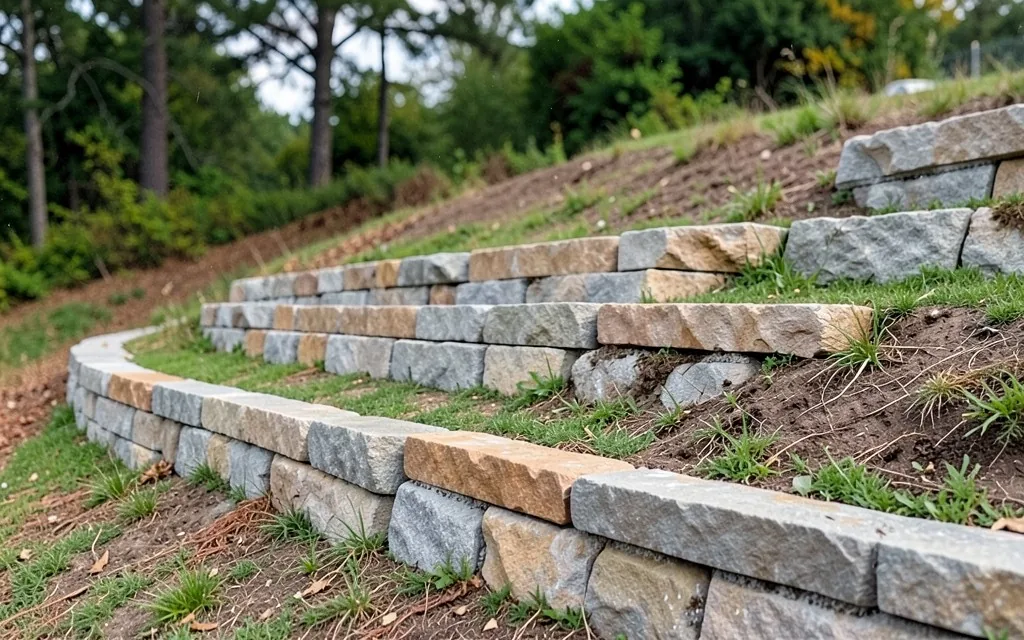
Retaining walls
Engineered for the retained height and the soil behind them, with drainage and geogrid where the design calls for it. Anything over about three feet is a structure, not a border.
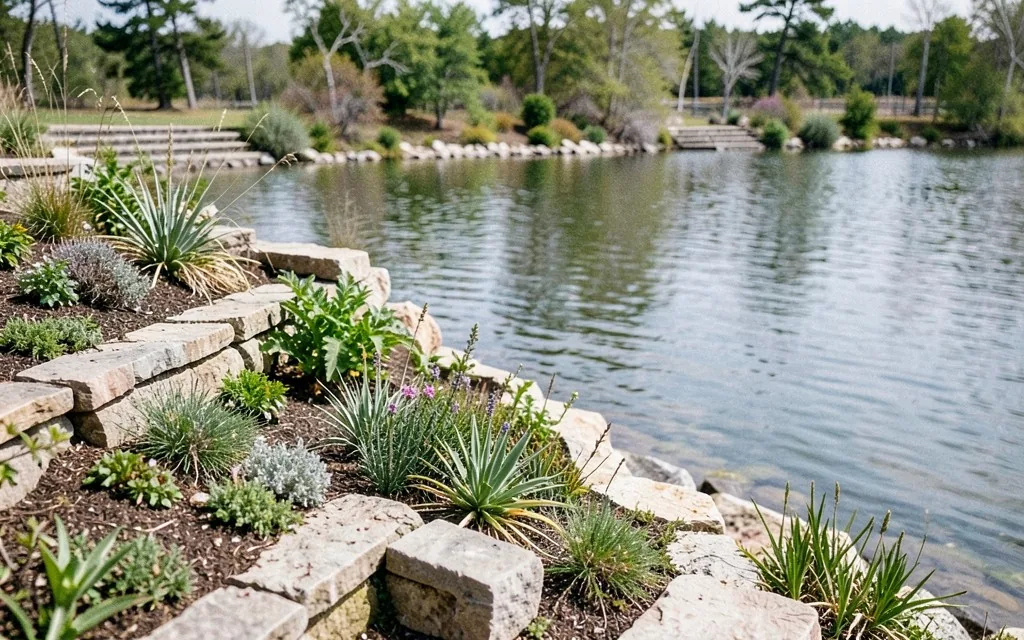
Waterfront and erosion control
Shoreline stabilisation, terracing and moisture-tolerant planting for Lake Conroe frontage. Erosion here is a water-velocity problem, and it is solved by grade and structure.
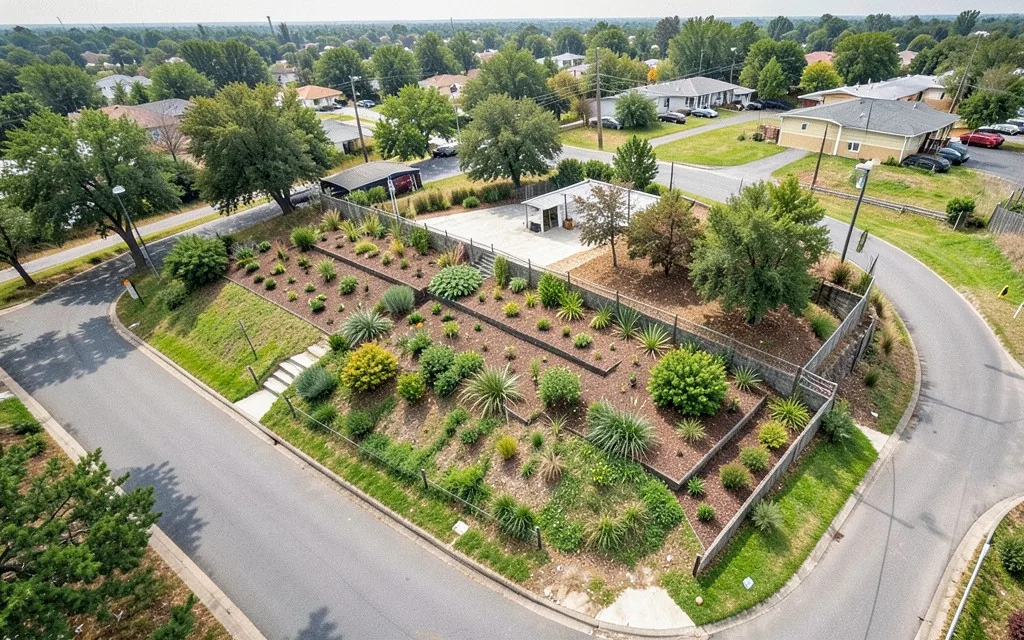
Landscape design
Surveyed and drawn to scale. On a sloped lot the survey is not optional — the levels decide the whole scheme.
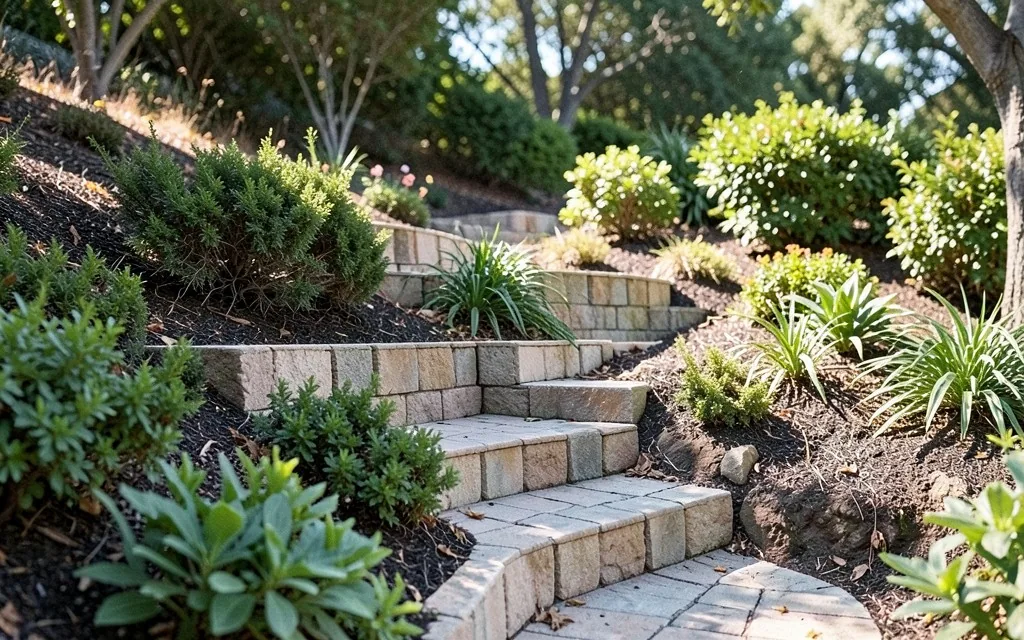
Hardscape and patios
Paver terraces, steps and walkways cut into slope, on compacted bases with the fall designed rather than inherited.
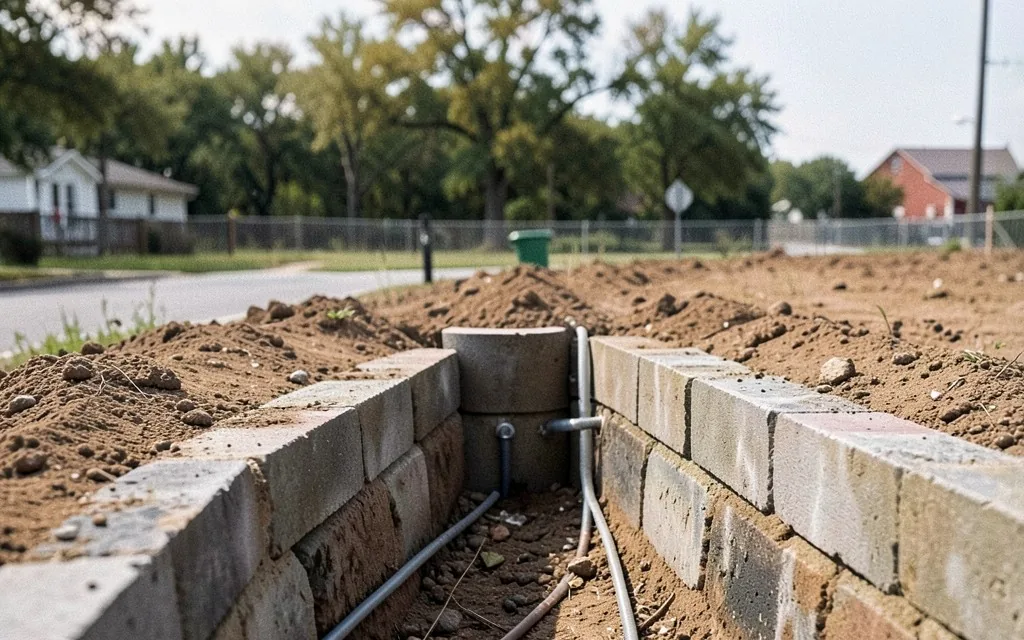
Drainage
French drains and regrading to control runoff before it reaches a wall or a foundation. On a slope, drainage is what keeps the structure standing.
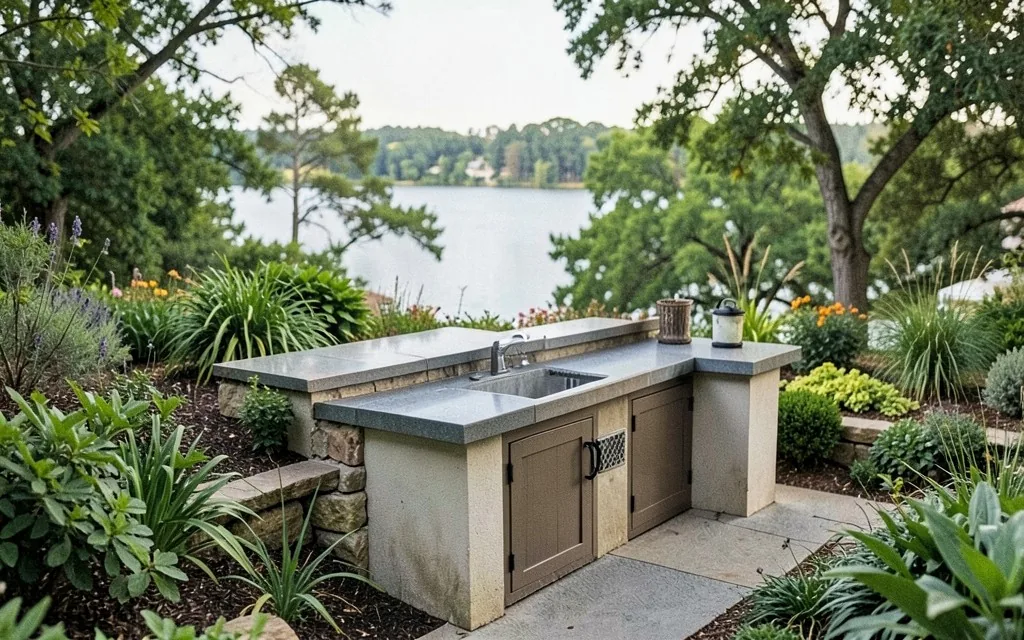
Outdoor kitchens
Kitchens and fire features built into terraces, designed with the wall rather than placed on it afterwards.
Local conditions
What goes wrong on a Conroe property?
Four failures, and three of them come back to water moving downhill.
Half the scheme thrives and half of it sulks
CauseOne plant list applied across a property whose soil changes from sandy to clay-heavy within a few hundred feet. The failures look random, so they get blamed on stock quality or watering and replaced with the same species.
FixSoil checked at several points before the schedule is written, and species assigned bed by bed. This is the commonest and least diagnosed problem on a Conroe property, and it costs nothing extra to get right.
Nothing establishes on a brand-new lot
CauseGrand Central Park and Woodforest are still building out, and a freshly finished lot is construction ground: compressed by traffic, stripped of topsoil and often backfilled with whatever was to hand.
FixThe compacted layer broken, topsoil brought back to real depth and organic matter incorporated before a single plant is installed. On new Conroe ground this is the majority of the first phase.
Plant selection that ignores the soil change
CauseA single list applied across a property that has sandy soil near the lake and heavy clay inland. Half the scheme thrives and half of it sulks, for no visible reason.
FixSoil assessed across the property rather than at one point, and planting selected bed by bed. This is the single most common cookie-cutter failure we are called to fix here.
Steps and paths that become unsafe
CauseSteps cut into a slope on unprepared ground, with inconsistent risers and no drainage across the treads. They settle unevenly within a couple of years, and a step that is half an inch out of line is what people actually trip on.
FixTreads set on a compacted base with consistent riser heights throughout the flight, cross-fall built in so water sheds rather than sits, and the whole run tied into the wall structure rather than resting against it.
Lakefront planting drowned or scorched
CauseStandard subdivision planting put on a shoreline. The moisture regime near the water is completely different from twenty feet up the bank, and the exposure is harsher.
FixMoisture-tolerant species at the water line grading into standard planting up the bank, with the transition designed rather than left to chance.
Specification
Communities we work in
Conroe covers new master-planned development and established lakefront estates, and the work differs sharply between them.
Grand Central Park and Woodforest
Rapidly growing master-planned communities with new construction. Builder grading, compaction and architectural review are the recurring three.
April Sound
Established lakefront with slope. Retaining walls, erosion control and drainage above the shoreline are the usual scope, alongside HOA review.
Walden on Lake Conroe
Mature waterfront community with substantial lots. Terracing, shoreline work and outdoor living designed around the lake view.
Bentwater
Lakefront estates where schemes run large. Engineered walls, extensive hardscape and site-wide lighting, usually phased across seasons.
River Plantation and Panorama Village
Established inland neighbourhoods on heavier clay. Drainage, hardscape renewal and shade planting are the common work.
Montgomery Trace and Del Lago
A mix of acreage and lakeside lots. Access, slope and where water can legally discharge are the constraints that shape the design.
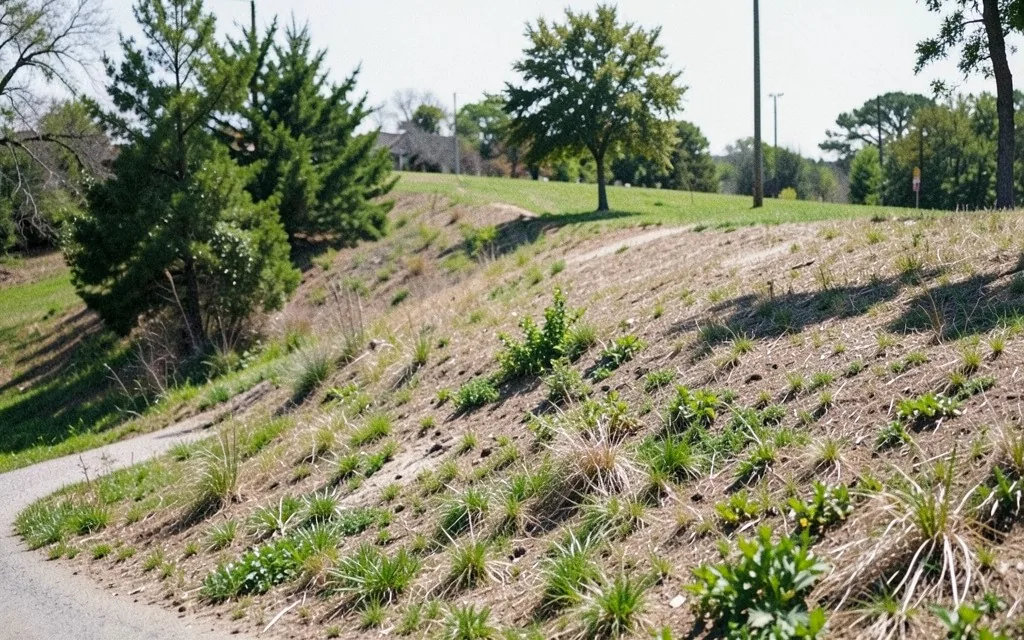
How it runs
Survey, engineer, build, plant
On sloped ground the survey and the wall design are the project. Everything else follows their levels.
- 01
Free on-site consultation
Slope, soil, runoff paths, existing walls and the view lines you actually care about. Access is checked here too, because it decides equipment.
- 02
Survey and design
Levels taken and the scheme drawn to them, to scale. On a slope, a design without contours is a picture.
- 03
Engineer the structures
Retaining walls designed for the retained height and soil, with drainage and reinforcement specified rather than assumed.
- 04
Approvals
HOA and community review packages prepared where required, with the review period built into the schedule.
- 05
Build from the bottom up
Walls, drainage and grade first, then terraces, hardscape, irrigation sleeves and planting on the finished levels.
- 06
Plant and hand over
Planting selected for the soil at each position, irrigation programmed, and establishment care explained before we leave.
What it costs
What does landscaping cost in Conroe TX?
2026 Conroe market rates. Slope engineering and lakefront requirements move these more than lot size does.
Basic landscape installation $5,000 – $15,000
Front yard improvements, new beds, planting, mulch and basic irrigation adjustment.
Comprehensive landscaping $12,000 – $40,000
The band most Conroe homeowners land in — design, planting, hardscape, irrigation and drainage as one project.
Paver patio installation $6,000 – $25,000
Terrace on a compacted base with the fall designed. Cutting into slope adds excavation and often a low wall.
Retaining wall $75 – $200 per linear foot
Priced by retained height and soil conditions. Drainage behind the wall and geogrid above roughly three feet are part of the specification.
French drain system $2,500 – $10,000
Depending on footage, structures and where the discharge point is. On a slope, drainage protects the walls as much as the house.
Lakefront transformation $25,000 – $150,000+
Shoreline stabilisation, terracing, extensive hardscape and planting on Lake Conroe frontage. Outdoor kitchens run $15,000 to $75,000 within this.
Recent work
Recent Conroe projects
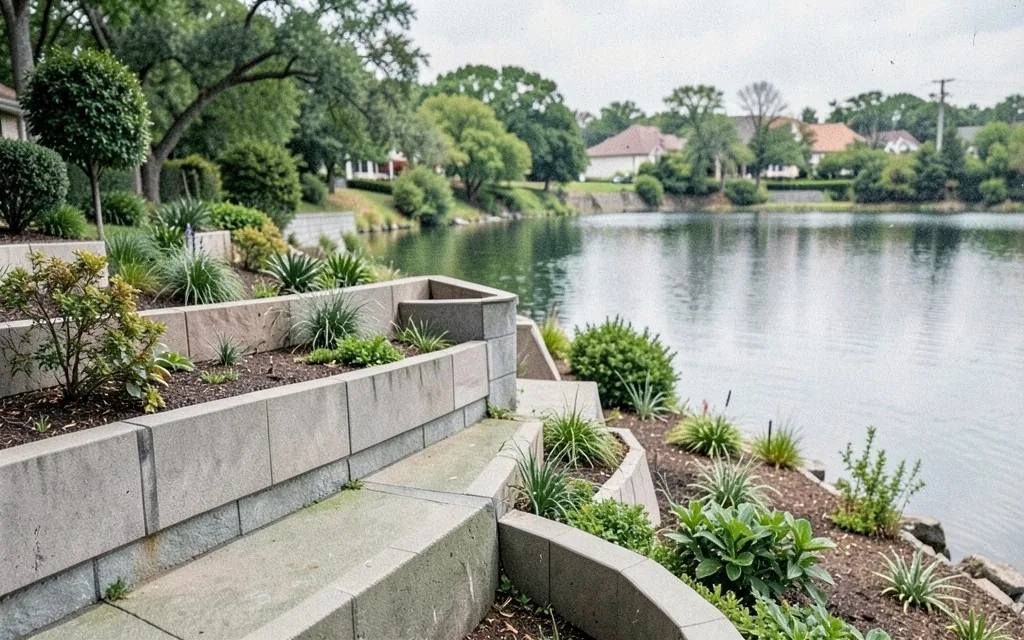
Walden on Lake Conroe
Terraced lakefront scheme with engineered walls, drainage behind each lift, and moisture-tolerant planting at the water line.
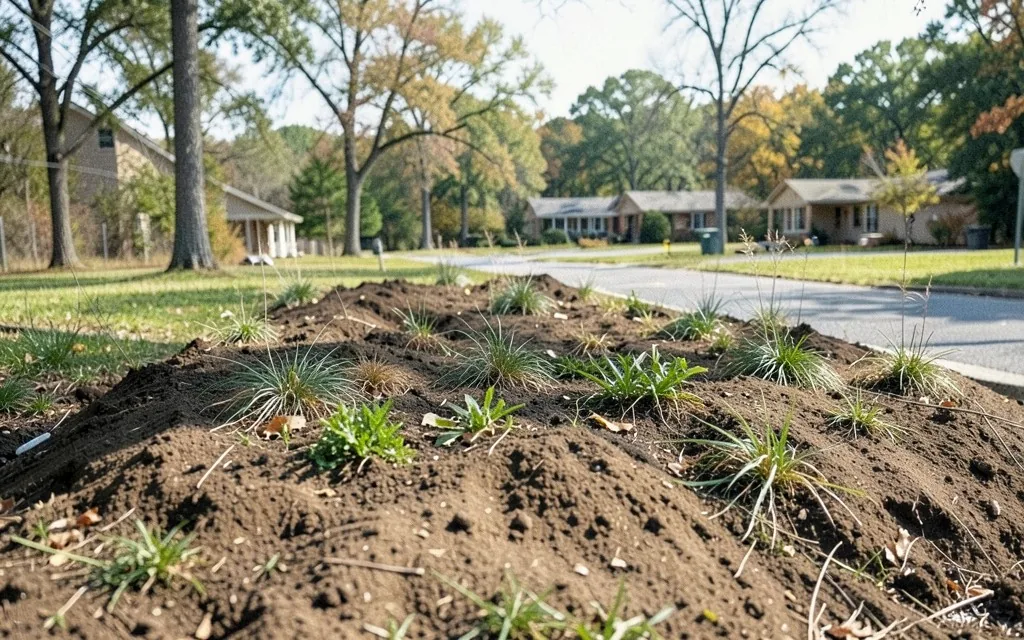
Grand Central Park
New construction where builder compaction was ripped and the grade corrected before any planting went in.
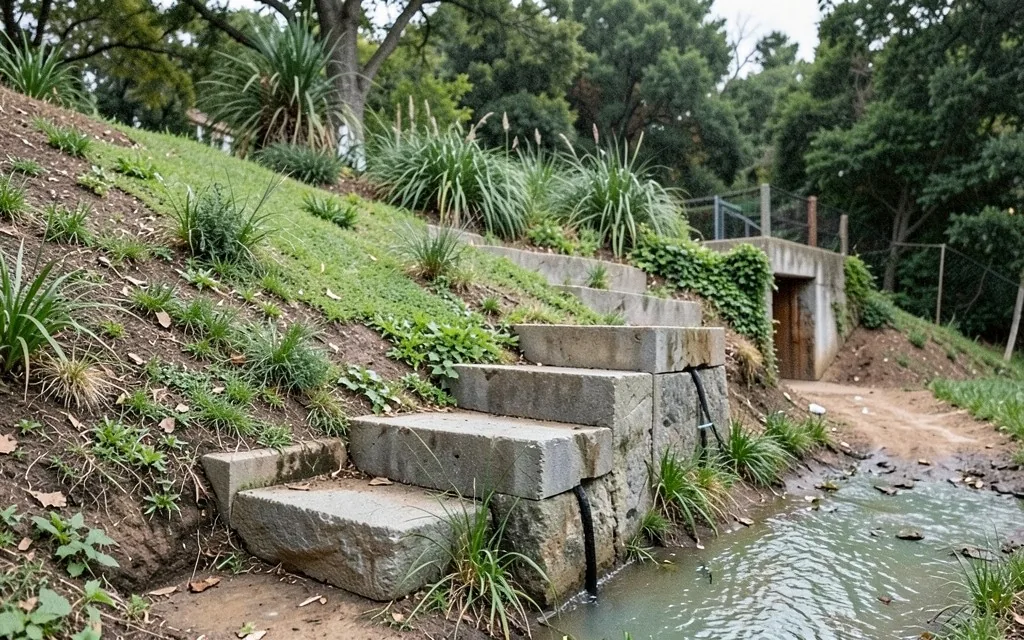
April Sound
Sloped garden terraced with steps and a terrace, with interception drainage above the bank to stop erosion.
Why homeowners choose us
Why Conroe homeowners use us
- 01
Soil tested at several points
Conroe sits on a sandy-to-clay transition. One plant list for a whole property is the local failure mode.
- 02
Levels surveyed
On sloped ground a design without measured contours cannot be built accurately or priced honestly.
- 03
Soil assessed across the property
Sandy near the lake, clay inland. One plant list for the whole lot is the local cookie-cutter failure.
- 04
Runoff intercepted before it moves soil
Terracing, swales and drainage above the planting. Vegetation holds soil that is already staying put.
- 05
New-build ground rehabilitated
Compaction broken and topsoil restored before planting. On a fresh lot this is most of the first phase.
- 06
One contractor, one number
Design, walls, drainage, hardscape, irrigation and planting under one accountable team.
Questions
Landscaping in Conroe TX — frequently asked
How much does landscaping cost in Conroe TX?
From around $5,000 for basic installations to $100,000 and up for lakefront properties. Most homeowners invest $12,000 to $40,000 for comprehensive landscaping. Paver patios run $6,000 to $25,000, retaining walls $75 to $200 per linear foot, French drain systems $2,500 to $10,000, and outdoor kitchens $15,000 to $75,000. Full lakefront transformations range from $25,000 to $150,000 and up.
Why does the soil vary so much across Conroe?
Because the town straddles a genuine transition. Ground nearer the lake tends to be sandier and faster-draining; move inland and it becomes noticeably more clay-heavy, holding water and shrinking in drought. Some properties have both. It is the reason a plant list that performs in one neighbourhood underwhelms two miles away, and it is why we test at several points rather than assuming a single soil type across a lot.
What plants grow best in Conroe TX?
It genuinely depends where on the property you are standing. Species that perform across both the sandy and clay ends include live oak, yaupon and dwarf yaupon holly, wax myrtle, Texas sage, gulf muhly and native perennials. Where the ground is sandier, drainage is fast and drought tolerance matters more; on the clay side, plants that resent wet feet in spring will struggle. The schedule is written bed by bed for that reason.
Do you work on new construction in Grand Central Park and Woodforest?
Frequently, and the earlier the better. A newly finished lot in these communities is construction ground: compressed by machinery traffic, stripped of its topsoil, and often backfilled with whatever material was available. Ripping the compacted layer, restoring topsoil to real depth and setting the grade before the drive and turf go in costs far less than retrofitting all three, and it largely determines whether anything ever thrives there.
How does Conroe terrain differ from the flat Houston suburbs?
Conroe has real relief — rolling ground, genuine slopes along FM 1097 and toward the lake, and level changes within single properties. That changes the work: terraces need steps with consistent risers, runoff arrives from uphill rather than sitting where it lands, and irrigation has to be zoned by elevation because water applied at the top of a bank runs off before it soaks in. Contractors set up for flat subdivision lots tend to underestimate all three.
Do you work with Conroe-area HOAs?
Regularly. Grand Central Park, Woodforest, River Plantation and the other organised communities here each have their own architectural review requirements and drawing standards. We read the documents before designing, prepare the submission package in the format expected, and build the review period into the schedule. Structures such as walls and permanent features are usually reviewed most closely.
Do you handle Lake Conroe waterfront work?
Yes — shoreline stabilisation, terracing and engineered walls on lakefront lots are a core part of what we do. Because it is a distinct discipline with its own engineering and approval requirements, we cover it in detail on our Montgomery and Lake Conroe page rather than repeating it here. If your property has frontage, start there and then call us.
When is the best time to landscape in Conroe?
October through March for planting, when soil is still warm and air temperatures are moderate enough for roots to establish before the next summer. Hardscape and earthwork are year-round in principle, but saturated ground stops grading entirely — and on Conroe slopes that matters more than elsewhere, because building on unstable material is how terraces and walls fail later.
How long does a landscaping project take in Conroe?
Design takes three to six weeks, plus review where a community requires it. Construction depends on scope: basic planting work is a few days, a comprehensive scheme two to four weeks, and a large project with substantial level changes six to twelve weeks. Rain is the main variable, because sloped ground cannot be compacted wet and much of the sequencing depends on the earthwork being sound.
Do you offer maintenance after installation in Conroe?
Yes. We run weekly and bi-weekly routes with dedicated crews, so the same team services your property each visit. That matters most in the first year, when new planting is establishing and small problems are still easy to reverse — and on a property with mixed soil it means someone who already knows which beds behave differently is the one looking at them.
Is Boone’s Landscaping licensed and insured?
Yes, and documentation is provided with the quote rather than on request. For engineered structures and for community review packages, contractor details are normally part of the submission, so having it in order is a practical requirement here rather than only a reassurance.
What makes Conroe lots different to work with?
The soil changes across town more than most people expect. North and west of the lake you are into sand over clay, while closer in it is heavy Beaumont clay that holds water for days. The same planting plan performs completely differently on the two, which is why the site assessment starts with a soil check rather than a plant list.
Where we work
Serving Conroe and Montgomery County
Conroe is a core service area, and we work throughout Montgomery County and into North Houston. Slope, the lake and the soil change across the area are what make local knowledge worth having here.
Often specified alongside: retaining walls, stairs and walkways, hardscaping and patios, French drains and drainage, landscape design, outdoor kitchens and fire pits, grading and dirt work.
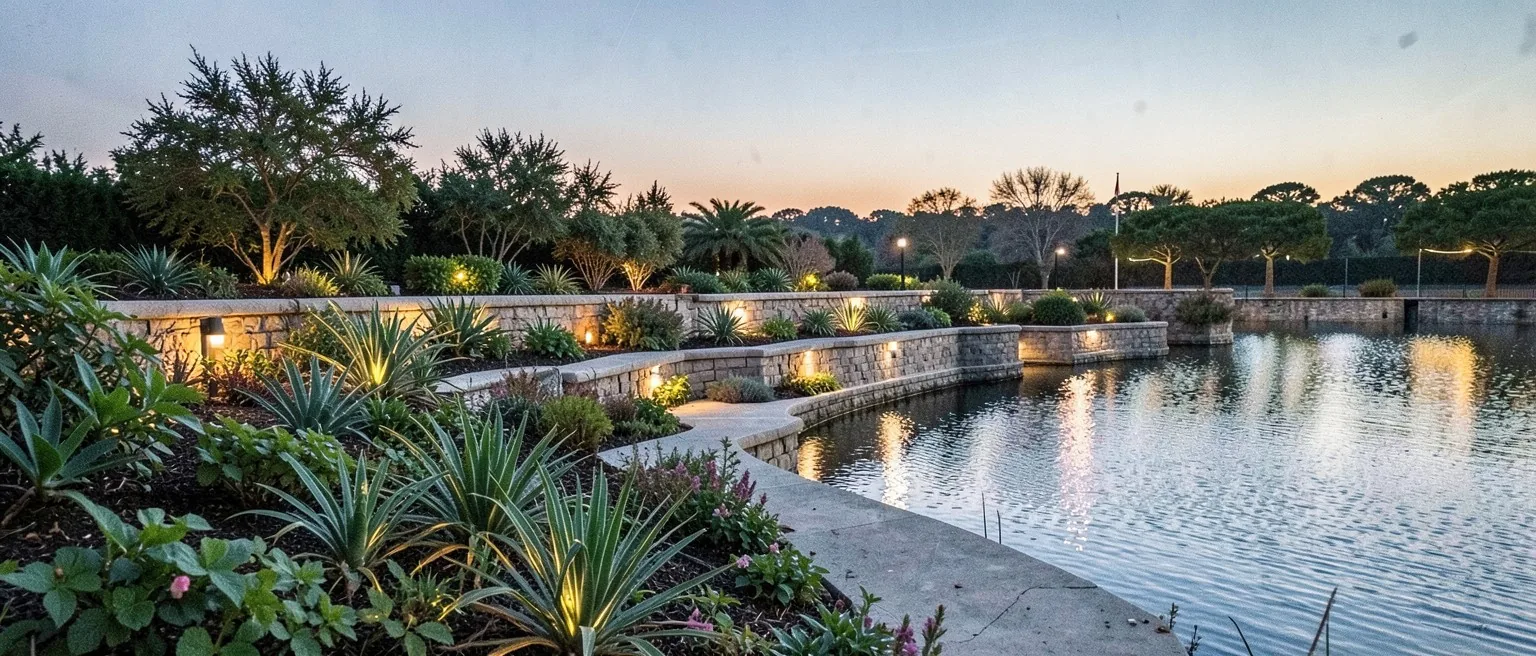
Start here
Book a Conroe site visit
We come out within 48 hours, take levels across the slope, check the soil at more than one point, and quote the wall against a design rather than a guess.