Skip to content
Free estimate (936) 206-7627

Planting & Xeriscaping · Conroe, TX

A Conroe front lawn, converted to a low-water bed

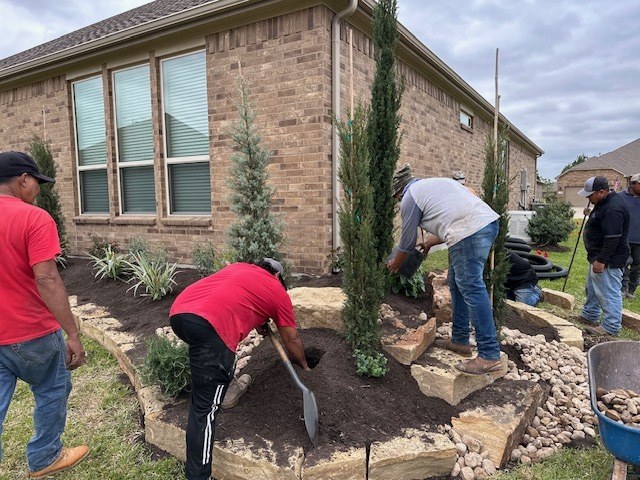
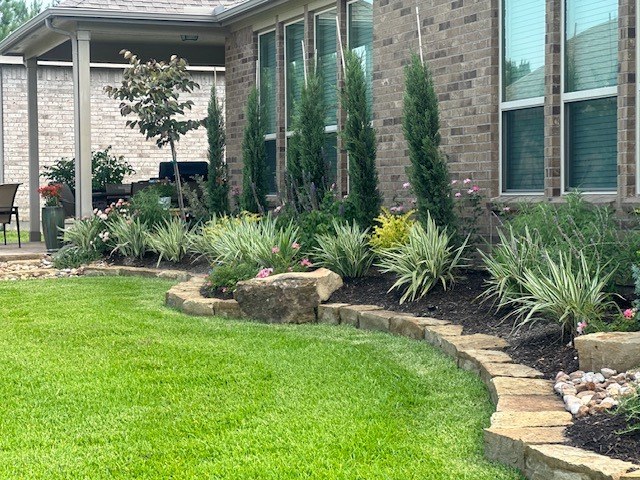
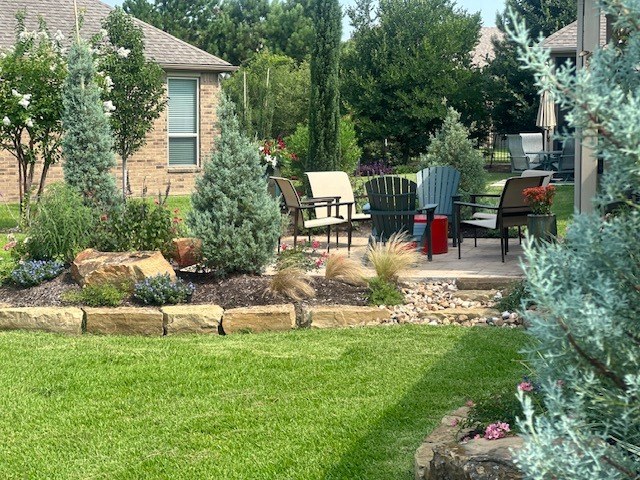
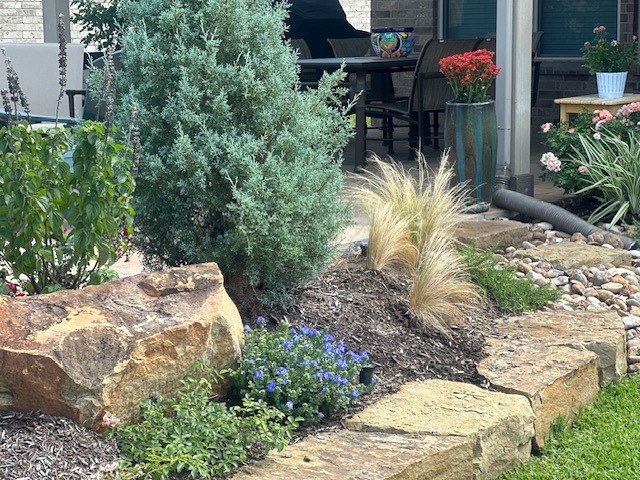
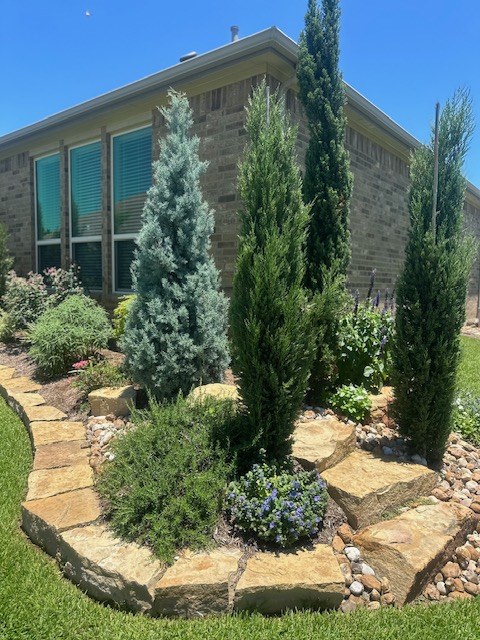
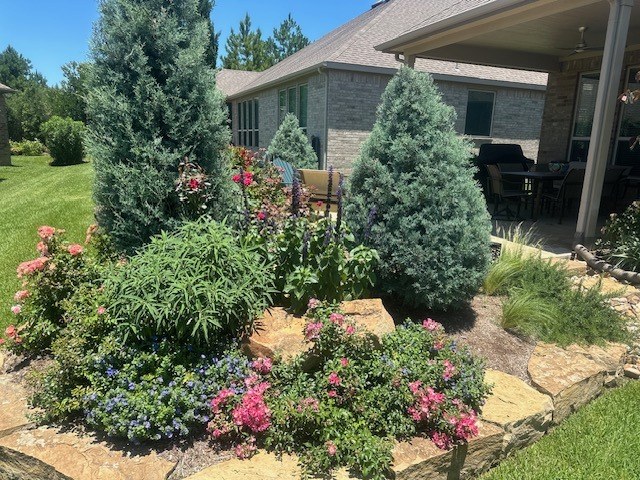
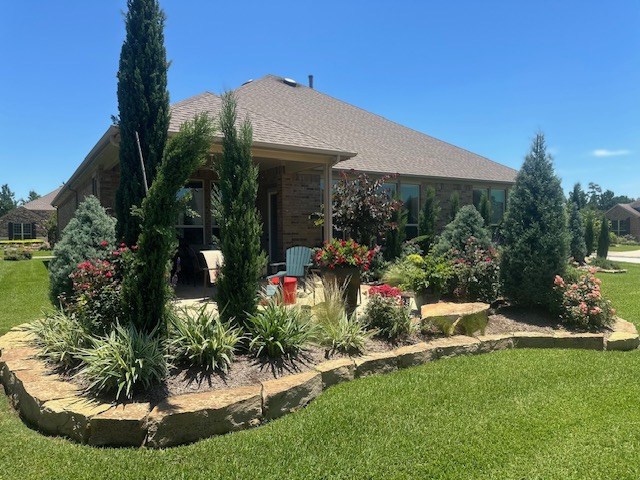
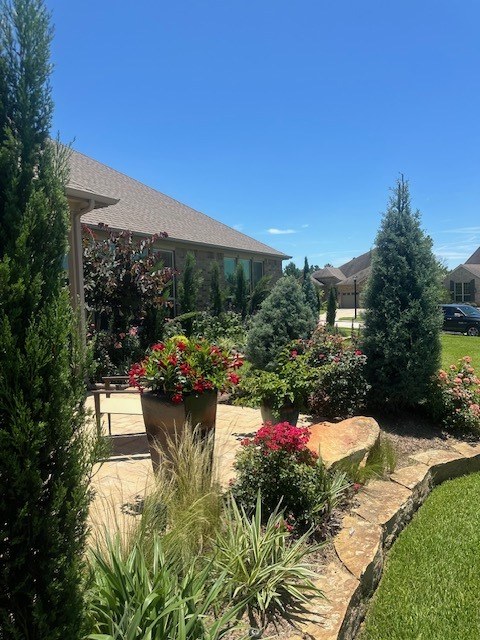
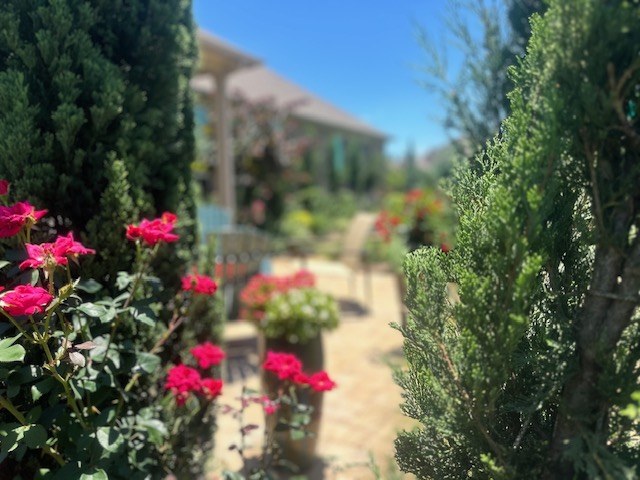
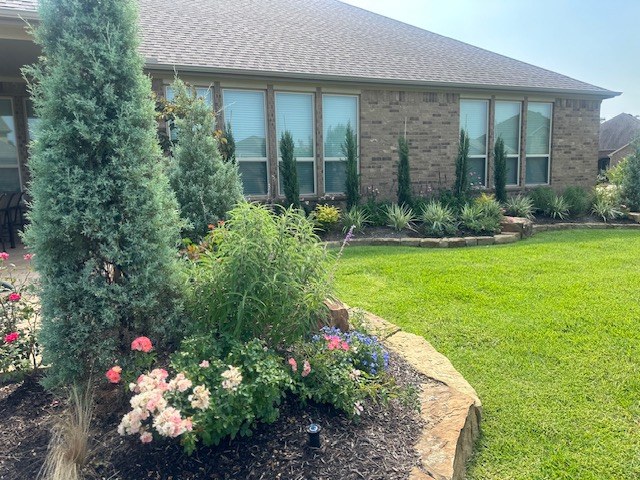
A front lawn on a brick home in Conroe was marked out, cut, and rebuilt as a boulder-and-gravel bed planted with Italian cypress, ornamental grasses, roses and agave. The turf that was there needed water it was never reliably going to get.

Before & after

The same ground, before the first cut

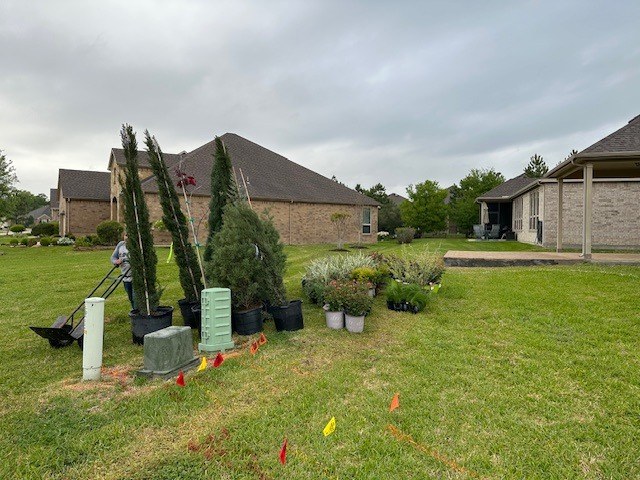
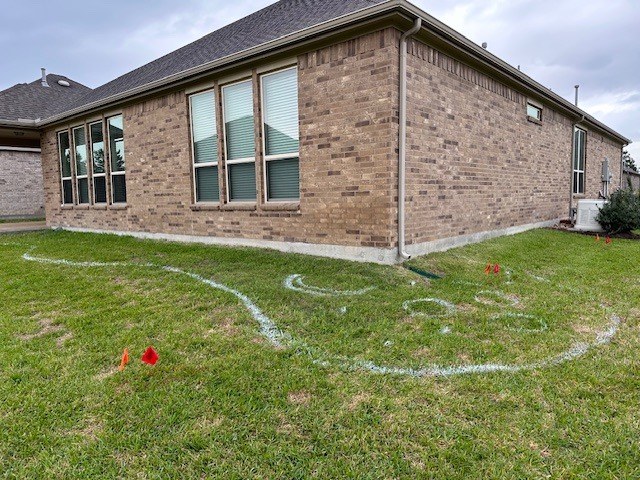
The first photograph in this set was taken before anything was cut. The curve of the finished bed is already on the grass in marking paint — the shape was agreed on the ground, at full size, before a spade went in.

Front-yard xeriscape conversion in Conroe, TX — after Front-yard xeriscape conversion in Conroe, TX — before
Front-yard xeriscape conversion Conroe, TX

What was there before

St. Augustine turf running to the foundation on the sun elevation, with no bed line and no planting structure. Grass met brick directly, which is the arrangement that causes the most trouble on a Montgomery County property: irrigation spray hits the wall, the strip closest to the foundation dries fastest, and there is nothing between the lawn and the house to hold the eye. The lawn was healthy enough. It was simply doing a job it is badly suited to on that aspect.
Why turf was the wrong surface on this elevation

Montgomery County sits on Beaumont clay. It holds water hard after a storm and shrinks in summer, which is why foundations move here and why a lawn that looks fine in April can be straw by August. St. Augustine on a hot elevation wants supplemental water through most of a zone 9a summer to stay green, and a front lawn on the sun side is the most expensive square footage on a property to keep alive and the least used. Converting it removes the demand rather than automating it — which is a different decision from adding a zone to the irrigation.


The economics

The saving is not in the install. It is in every summer afterwards, and it compounds.

Marking out before cutting

The bed line was painted onto the existing grass and looked at before any turf came up. This matters more than it sounds. A curve that reads well on a plan can be wrong on the ground, because the eye judges it against the roofline and the drive, not against a drawing. Painting it full size means the shape can be walked, viewed from the street and from the front door, and adjusted while adjusting still costs nothing.

Why the stone was set first

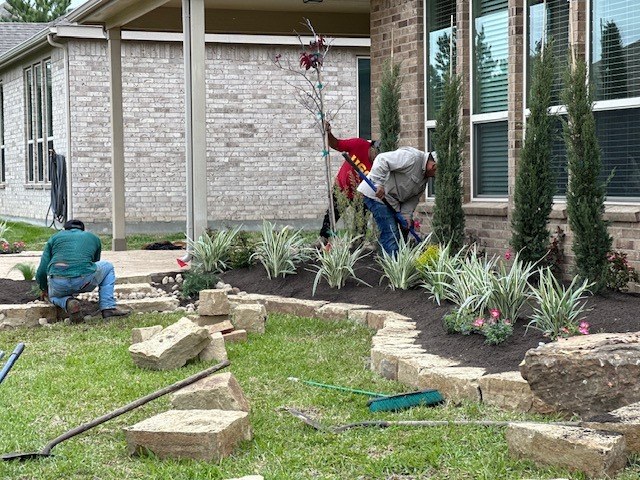
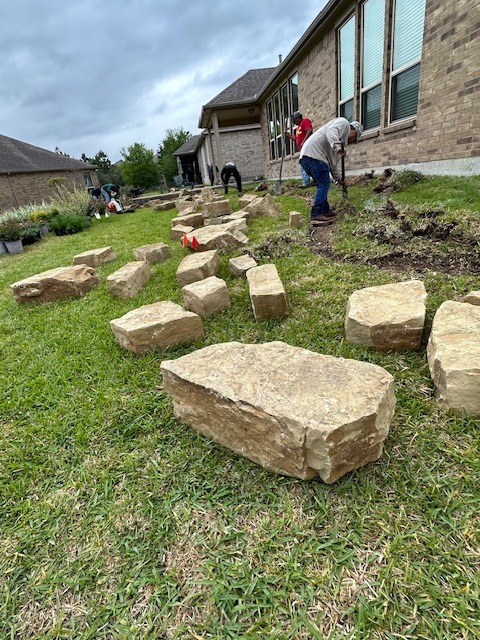
Boulders went in before a single plant did. They are the heaviest things in the design and the only elements that cannot be nudged once everything else is in — setting them last means working machinery around new planting and fresh gravel. Placing them first also fixes the composition: every plant afterwards is positioned in relation to stone that is already where it will stay. The sequence in the photographs is deliberate and it is the sequence that produces less damage and less rework.

Specification

What went in

Surface removed
St. Augustine turf, cut and lifted
Base
Gravel base laid to depth over cleared ground
Stone
Set boulders, placed before planting
Structure planting
Italian cypress
Understorey
Ornamental grasses, roses, agave
Soil
Beaumont clay
Zone
USDA 9a
Aspect
Sun elevation, open
Irrigation
Establishment only
Maintenance
Annual cutback, seasonal pruning, stone top-up

The base, and what it is actually for

Turf was cut and lifted rather than sprayed and planted through, so the bed starts clean rather than starting with dying grass under it. Gravel was then laid to depth over the cleared ground. Depth is the whole point: a thin scatter of stone is decoration and weeds come straight through it, while a proper depth suppresses germination, moderates soil temperature and stops clay from pumping up through the surface after heavy rain. On clay this last part matters — a shallow gravel bed on Beaumont clay turns muddy from below, not from above.

What happens to it in a Gulf storm

This is the question that matters most on Beaumont clay and the one most gravel beds fail. Clay does not drain — after a heavy storm the water has nowhere to go downward, so it moves sideways and it sits. A bed built on a thin stone layer turns to a clay-and-gravel slurry the first time that happens, because the substrate pumps upward through the stone as the ground saturates and then shrinks. Depth is what prevents it: enough base that the stone layer stays a stone layer, with the clay held below it. The planting then has to survive the other half of the problem, which is that a drought-tolerant palette in this county must also tolerate periodic saturation. That is a narrower list than 'plants that like dry conditions', and it is why the species here lean Mediterranean and desert rather than true xeric — agave and rosemary-type structure will take a wet week; many genuinely arid plants will not.

The build

12 photographs from this project

A Conroe front lawn, converted to a low-water bed in Conroe, TX

The planting palette, and why each element is in it

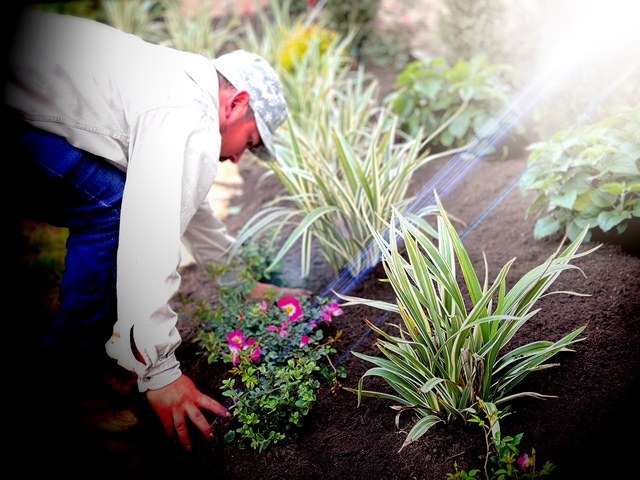
Italian cypress supplies vertical structure against a low brick elevation, which is the one thing a single-storey front cannot generate on its own. Ornamental grasses soften the boulder edges and add the only movement in the scheme. Roses carry colour through heat that would exhaust most flowering shrubs here. Agave is the drought anchor and the element that makes the bed legible as a dry planting rather than a normal border that happens to have stone in it. It is a palette chosen for a hot, well-drained, open bed — the same list would fail under the pines a few miles north, where the same property type wants shade planting instead.

What it costs to run now

The bed needs establishment watering and then very little. The lawn it replaced needed supplemental irrigation through the hottest three to four months every year, indefinitely, to look the way it did in the first photograph. That is the real economics of a front-yard conversion in this climate: the saving is not in the install, it is in every summer afterwards, and it compounds. The lawn that remains is the part that gets walked on, in the shape that was drawn on the grass at the start.

Upkeep

What a bed like this asks for, month by month

What a bed like this asks for across a Montgomery County year. It is not weekly work, but it is not nothing, and the jobs are seasonal rather than continuous.

  1. Jan – Feb

    Cut back

    Grasses cut hard before new growth starts, roses pruned on the normal late-winter schedule. Doing it before the flush matters more than doing it on a date.

  2. Mar – Apr

    Stone and weeds

    First weed pass of the year, and top up stone where it has migrated over winter — usually at the bed edges and anywhere feet cross.

  3. May – Jun

    Establishment water

    In the first year only, water through the initial heat while roots establish. An established bed of this type needs no summer irrigation here in a normal year.

  4. Jul – Aug

    Leave it alone

    Peak heat is the wrong time to cut, feed or move anything. Watch the agave for crown rot in the week after a heavy storm; that is the one summer failure mode worth checking for.

  5. Sep – Oct

    Second weed pass

    The autumn germination flush is smaller than spring's but it is the one people miss. Assess cypress for width rather than height while you are in there.

  6. Nov – Dec

    Nothing

    No cutting back before the first hard cold — the top growth protects the crown. This is the quietest quarter in the bed's year.

What it needs from here

Gravel beds are low-maintenance, not no-maintenance. Expect to top up stone where it migrates, cut the grasses back once a year before new growth, prune roses on the normal schedule, and pull the small number of weeds that will find their way in regardless of base depth. The cypress will want watching for width rather than height. None of this is weekly work, which is the point.

Whether a conversion suits your property

Four conditions decide it, and they are worth checking before anyone quotes. Aspect: a sun elevation is the strongest candidate, because that is where turf costs the most to keep. Use: if children or dogs actually play on that lawn, keep the lawn — this is a conversion for the ornamental front, not for the part of a garden that gets walked on. Drainage: if that area already holds water after rain, the drainage gets solved first and the bed second, in that order, or the bed inherits the problem. And the deed restrictions — several Montgomery County communities set minimum turf coverage on the front elevation, so the ratio of bed to lawn is sometimes decided for you before the design starts. None of those four is a reason not to do it; all four change what gets drawn.

Before you ask

Questions this project usually raises

Will a gravel bed make the house hotter?

Light-coloured stone reflects more than turf does, so a large gravel area on a west elevation can add radiant heat close to the wall. It is managed by planting rather than by avoiding stone — structure planting between the bed and the brick intercepts most of it, which is part of why the cypress sit where they do.

Do you have to remove the turf, or can you build on top of it?

Cut and lift it. Building over living St. Augustine means it dies under the base and leaves voids as it breaks down, so the bed settles unevenly in the first year. It also runs, and it will find the edges of a bed laid over the top of it.

Does this work on Beaumont clay?

Yes, and base depth is what makes it work. Clay does not drain, so the gravel layer has to be deep enough to stay a gravel layer rather than becoming a clay-and-gravel mix after the first serious storm. Plant selection then has to tolerate the fact that water sits, which is why the palette leans on species that handle both drought and periodic saturation.

How long before it looks established?

The structure reads immediately, because the boulders and the cypress are full size on day one — that is a real advantage of this kind of scheme over a conventional border. The grasses and roses take a season to fill the gaps between them.

Does a gravel bed need a weed barrier underneath?

Base depth does more than fabric does, and fabric causes its own problems over time: it clogs, it stops organic matter reaching the soil, and it surfaces in shreds once stone migrates over it. Weeds that arrive in a well-built bed mostly germinate in debris that has collected in the stone, which is a housekeeping problem rather than a barrier problem.

Can you convert only part of a front lawn?

That is usually what happens, and it is what happened here. The lawn that gets used stays; the strip against the elevation that costs the most to keep green is what converts. Deed restrictions in some communities make a partial conversion the only option anyway.

What does it cost to maintain compared with lawn?

The comparison is not really install against install. It is the cost of irrigating turf on a hot elevation through three or four months of a zone 9a summer, every year, against an annual cutback, two weed passes and an occasional stone top-up. The gap widens each year and it widens faster in a drought year.

A Conroe front lawn, converted to a low-water bed in Conroe, TX

Free estimate

Thinking about the same conversion?

Every property here sits on the same clay and the same heat. What changes is aspect, drainage and what you actually use the space for — which is what the first site visit is for.

Call now Free estimate