
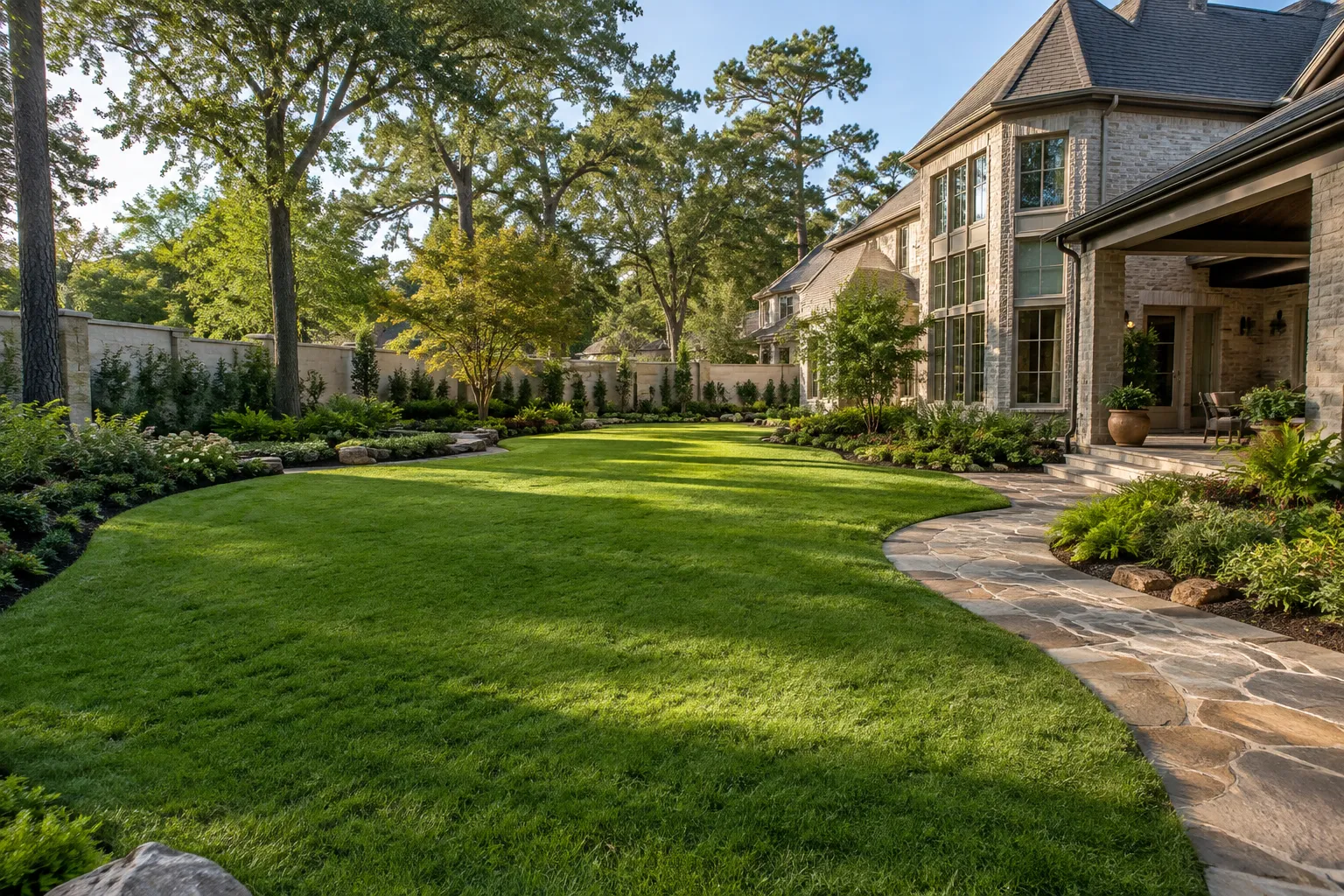
Land & Yard Grading Contractors in Conroe & Houston
Large-property grading should begin with measured elevations and a clear purpose.
Family-owned since 2010 · Own crews · Licensed & insured · Free written estimates
Large Property Grading & Drainage requirements
Moving soil until the yard looks level can create new drainage problems or affect retained trees and structures. The plan needs to show the proposed surface and how it connects to the parts of the property that will remain unchanged.
For large property grading & drainage work in Houston, Conroe, Magnolia or Spring, send Boone’s the address, a few photos of the area and what you want done. Boone’s is based in Montgomery, TX.
Services
What Boone’s handles for large property grading. Each is priced after we walk the property.
Existing levels and grading objectives
Record the starting conditions, low points and relevant thresholds. State whether the work creates usable lawn, supports construction or corrects surface runoff. A visual impression of slope is not a reliable basis for deciding how much material to move or where the finished surface should lie.
Keep a fixed reference point outside the disturbed area and identify the drawing revision used for setting out. A midway change should produce an updated target, not two conflicting instructions to the equipment operator.
Runoff routes and receiving areas
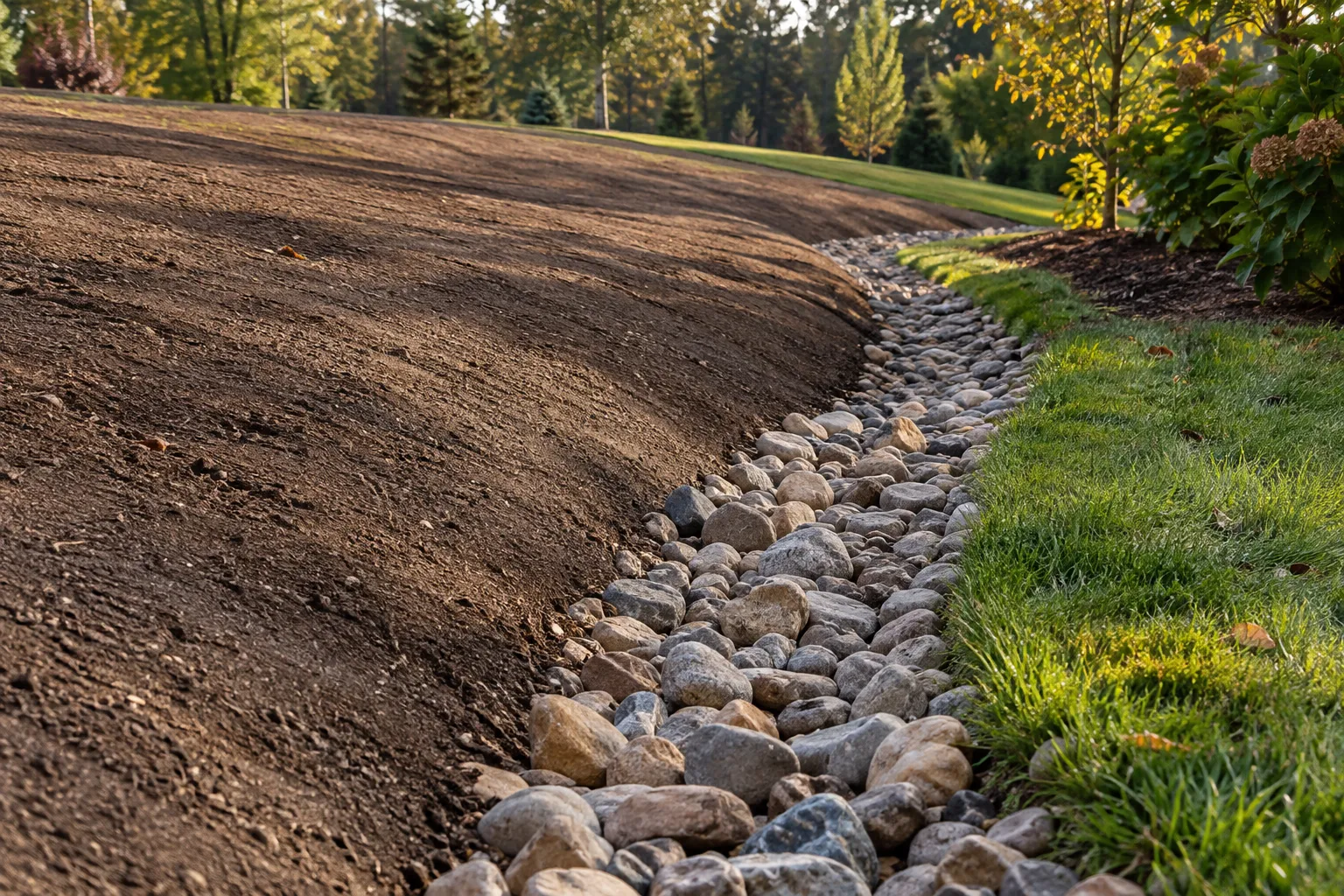
Trace where water will travel after the proposed reshaping. Consider the actual destination rather than simply moving a wet area farther from view. Any discharge and boundary implications need site-specific review; this page does not imply permission to send runoff onto another property.
Distinguish frequent nuisance ponding from the route water may take in a larger storm. Both merit discussion without promising every rainfall can be contained. Keep any unresolved receiving-area constraint visible before approving earthmoving quantities.
Topsoil, fill and material suitability
Distinguish soil intended for planting from material intended to support structures or paving. Excavated material is not automatically suitable for either purpose. Identify what can be reused, what needs assessment and how separate materials will be handled instead of mixing everything into one unverified grading layer.
Material deliveries may require smaller vehicles or staged unloading where access is limited. Clarify whether quantities describe loose supplied material or its finished position. Otherwise two prices may appear comparable while measuring different things.
Retained trees and existing services
Mark areas where changing grade or moving machinery could affect roots, buildings or utilities. A retained tree's trunk may remain untouched while its root environment is substantially altered. Review protection and constraints before establishing equipment routes or choosing the apparent easiest place for a temporary stockpile.
Photograph retained surfaces and planting before work starts and mark the permitted disturbance boundary. Include turning and storage areas: they may need restoration even where their final grade remains unchanged.
Grading sequence and surface stabilization
Plan the sequence so partially completed ground does not create avoidable runoff or erosion problems. Coordinate the finished surface with planting or other stabilization appropriate to the project. The work is not complete merely because the last machine has left a smooth-looking soil plane.
Choose an exit that does not repeatedly cross accepted ground. Preserve access for final sod, seeding or planting without reopening finished slopes. Later deliveries should not use completed areas as an unplanned shortcut.
Finished-grade review and scope confirmation
Compare final levels and water routes with the agreed plan. Document any areas requiring further technical assessment instead of treating a dry-weather photograph as proof of performance.
Keep the final level record and dated photographs together. Agree how later settlement or observed ponding is reported and assessed. This creates a comparison point without turning one rainfall observation into an unlimited performance warranty.
Talk to Boone’s about large property grading
Own crews, licensed and insured, working Conroe, Houston and Montgomery County since 2010.
How it works
How a large property grading project starts
- 01
Call or send photos
Call (936) 206-7627 or use the form with the address and a few photos of the area.
- 02
We walk the property
We look at the site, the light, the soil and the access before anything is priced.
- 03
Written estimate
You get a detailed estimate in writing at no cost, and the work is done by our own crews.
Questions about large property grading & drainage
Is grading the same as making the yard level?
No. Useful grading sets levels and slopes for the intended use and water route. A flat surface can still hold water in the wrong place. Begin with measured conditions and a destination for runoff rather than an instruction to flatten everything.
Can grading be done after new planting is installed?
That sequence can damage roots or bury stems and irrigation. Coordinate ground levels first wherever possible. If existing planting must remain, assess protection and feasible level changes before moving soil, instead of treating plants as items that can simply be worked around.
Does soil brought to the site have to be specified?
Yes, its intended role should be clear. Material used as planting soil is not automatically appropriate structural fill, and vice versa. State the source, suitability checks and where each material will be placed so a generic load of dirt does not stand in for the specification.
What changes the grading estimate besides acreage?
Existing and target levels, soil quantities, access, export or import, protected features and stabilization requirements all affect scope. A small constrained area can be more complicated than a large open one. Compare proposals against the same measured objectives rather than area alone.
Related plants and projects
Foundation Drainage Installation
Foundation drainage work should identify the source and route of water before a pipe is proposed.
Clay Soil Drainage Installation
Clay-soil drainage begins by distinguishing slow soil infiltration from a surface that simply traps water.
Large Property Earthworks
Large-property excavation needs a defined purpose, measured limits and a material-handling plan.
Estate Landscape Master Planning
An estate landscape master plan should resolve how the whole property works before individual features are ordered.
Tree Planting
Tree planting should match the actual tree to a place where it can develop.
Get a free estimate for large property grading
Call (936) 206-7627 or send the address and a few photos through the form. We walk the property and put the price in writing at no cost.