
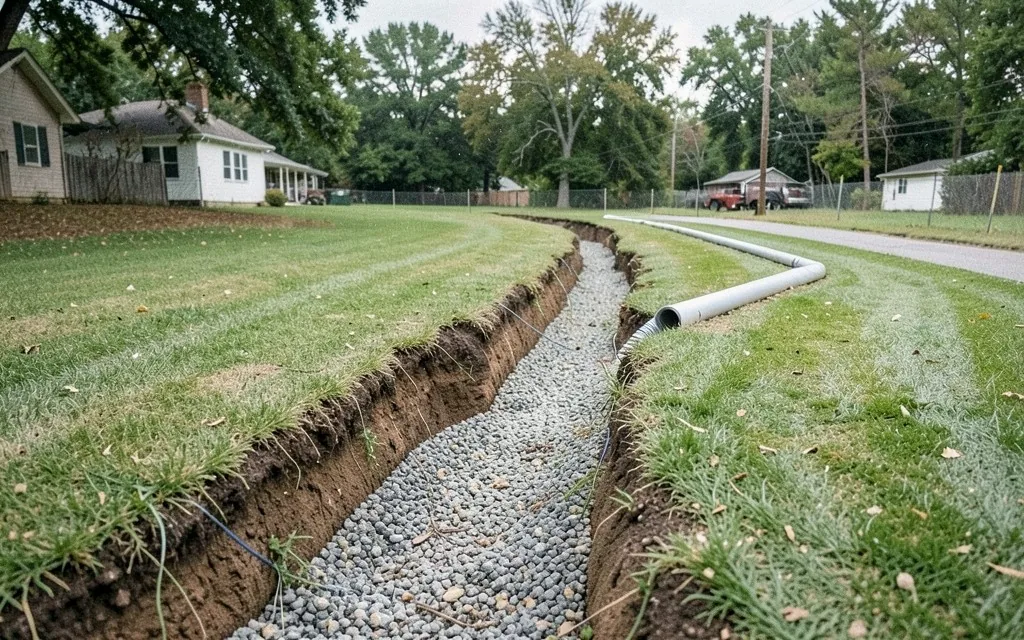
Prepare for a yard drainage assessment by documenting where water appears, when it happens and what lies around the affected area. Bring that evidence to the site discussion before choosing a drain type. A useful proposal connects the observed problem, the required assessment, the proposed work and the responsibility for discharge and restoration.
Document the drainage problem without choosing the solution
Use photographs and a simple property sketch. Mark the location of standing water, visible flow and the places you need to keep usable. Note whether an observation followed rain, irrigation or another event. If you have several observations, date them. A photograph of one event is evidence of that event, not a measurement of every storm.
Observe from a safe location. Do not enter floodwater, an excavation or an unstable area to collect better photographs. For an immediate hazard, address safety first; this planning worksheet is for arranging an assessment, not for managing an emergency.
Bring property records and recent changes
Collect any survey, drainage drawing or previous work record you already have. Label records whose accuracy is uncertain. Include recent paving, additions, planting changes, new downspout arrangements or construction traffic. Note access restrictions and retained features near the affected area.
Distinguish your observations from your explanation. “Water remains beside this step after rain” is an observation. “The neighbor caused it” is a conclusion that needs evidence. Keeping those separate helps the assessment focus on conditions that can actually be checked.
Ask how the drainage proposal addresses the observed water
A named product is not a complete explanation. Ask what information supports the proposed approach, what conditions it assumes and what needs confirmation before work begins. Where levels, buried services, discharge arrangements or other constraints require investigation, assign that work explicitly.
| Record | Useful detail |
|---|---|
| Location | Mark the affected area and nearby structures or surfaces. |
| Timing | Note the event and when you observed the water. |
| Changes | List recent work or altered irrigation and roof-water routes. |
| Constraints | Identify access, retained trees and known services. |
| Open decisions | Assign assessment, discharge questions and restoration. |
Compare drainage scope and restoration
Check whether excavation, protection, removal, reinstatement and cleanup are included. A proposal that restores turf is different from one that leaves that work to another party. Record what happens where the work crosses planting, paving or an irrigation line.
Confirm how changes will be agreed if the site investigation reveals different conditions. Ask how completion will be assessed and which observations or records will be provided at handover. Do not turn a description of the intended result into a guarantee about every future weather event.
Prepare your drainage assessment checklist
- Mark the affected area on a sketch.
- Date photographs and record the event.
- Collect available drawings and past work records.
- Separate observed conditions from assumptions.
- List access, retained features and known services.
- Compare the assessment, work and restoration scope.
Start with yard drainage services. The assessment may also involve questions about grading or French drains; the site findings should determine the relevant work. Coordinate any lawn replacement with the sod installation guide.