
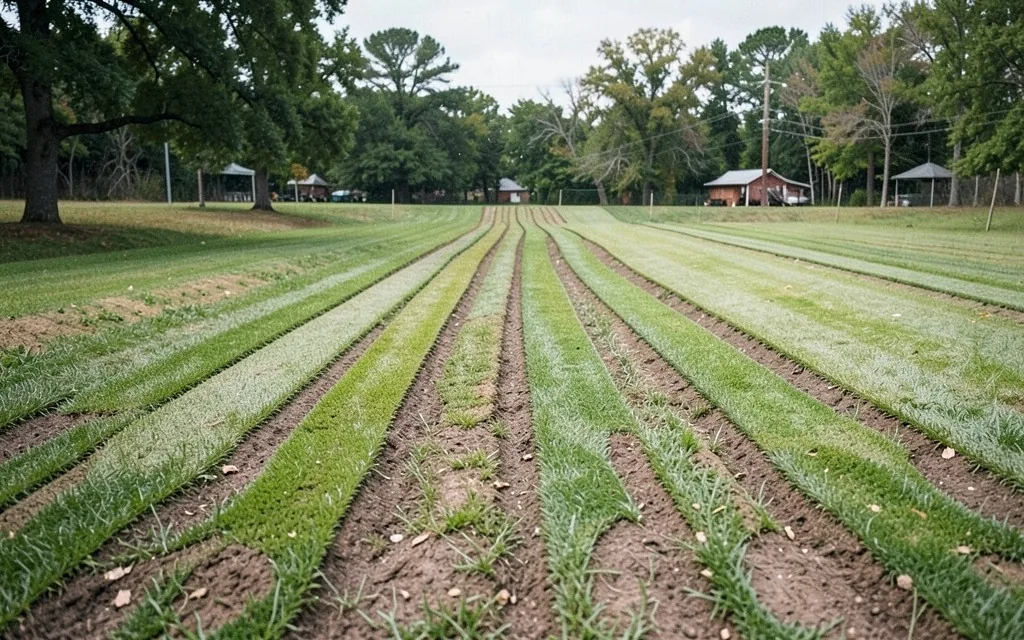
Prepare for sod installation by establishing why the existing lawn is struggling and agreeing what happens before, during and after the new turf is laid. Compare the same measured area, preparation, grass selection and care arrangement. Replacement turf should be part of a site-specific renovation plan, rather than the only item in the discussion.
Record the lawn conditions before requesting sod
Mark bare patches, wear routes, shaded areas and places that remain wet. Photograph them and note when the problem occurs. Include information about recent construction, changes to the planting or work on the irrigation system. The purpose is to give the site visit a reliable starting point, not to diagnose every cause from a photograph.
Texas A&M AgriLife's turf-establishment guidance emphasizes site and soil preparation, appropriate planting methods, grass selection suited to the site, and care after planting. Use those topics to structure the scope discussion. A grass recommendation should account for the actual property rather than the appearance of a neighboring lawn.
Compare the preparation included in each sod quote
Ask how the existing surface will be handled and what preparation is included. The proposal should identify the work area, removal or treatment assumptions, soil work, level changes where applicable, supply, installation, cleanup and restoration. “New sod” alone does not tell you whether the proposals cover comparable work.
| Scope item | Question to answer |
|---|---|
| Area | Which boundaries and exclusions define the installation? |
| Preparation | What happens to the current turf and underlying surface? |
| Grass | What selection is proposed and why does it suit this site? |
| Irrigation | What is checked, adjusted or repaired, and by whom? |
| Handover | Who supplies the care instructions and who carries them out? |
Coordinate drainage and irrigation before installation
Identify unresolved wet areas before treating the lawn finish as the complete project. Where a separate assessment is needed, record its owner and how its findings affect the work sequence. Avoid approving a finished surface while leaving a known site question unassigned.
Discuss the condition and coverage of the existing irrigation system and whether repairs are part of this proposal or a separate service. Ask who confirms readiness before the sod arrives. Keep access available for the work and agree how adjoining beds, paving and retained features will be protected.
Agree the sod care and handover arrangement
Ask for instructions specific to the supplied grass and the installation conditions. Record who waters, monitors the lawn, arranges mowing and raises concerns. Do not substitute a generic watering timetable for the installer's site-specific instructions or applicable water-use requirements.
Before handover, walk the agreed installation boundary and note outstanding items. Keep the final grass selection, care instructions, proposal and any written coverage terms together. Resolve a question about an omission by referring to the documented scope, rather than assuming every lawn-related service was included.
Prepare for a sod installation discussion
- Mark the replacement area and problem patches.
- Photograph shade, wear and wet areas.
- Compare removal and preparation inclusions.
- Confirm the proposed grass and site assessment.
- Assign irrigation and drainage questions.
- Agree who performs the initial care.
Read about Boone's sod installation service and irrigation repair. If water is the unresolved issue, use the drainage assessment preparation guide first.
Reference: Texas A&M AgriLife: Turfgrass Establishment for Texas, read November 13, 2026. The worksheet is original editorial guidance, not an installation specification.