
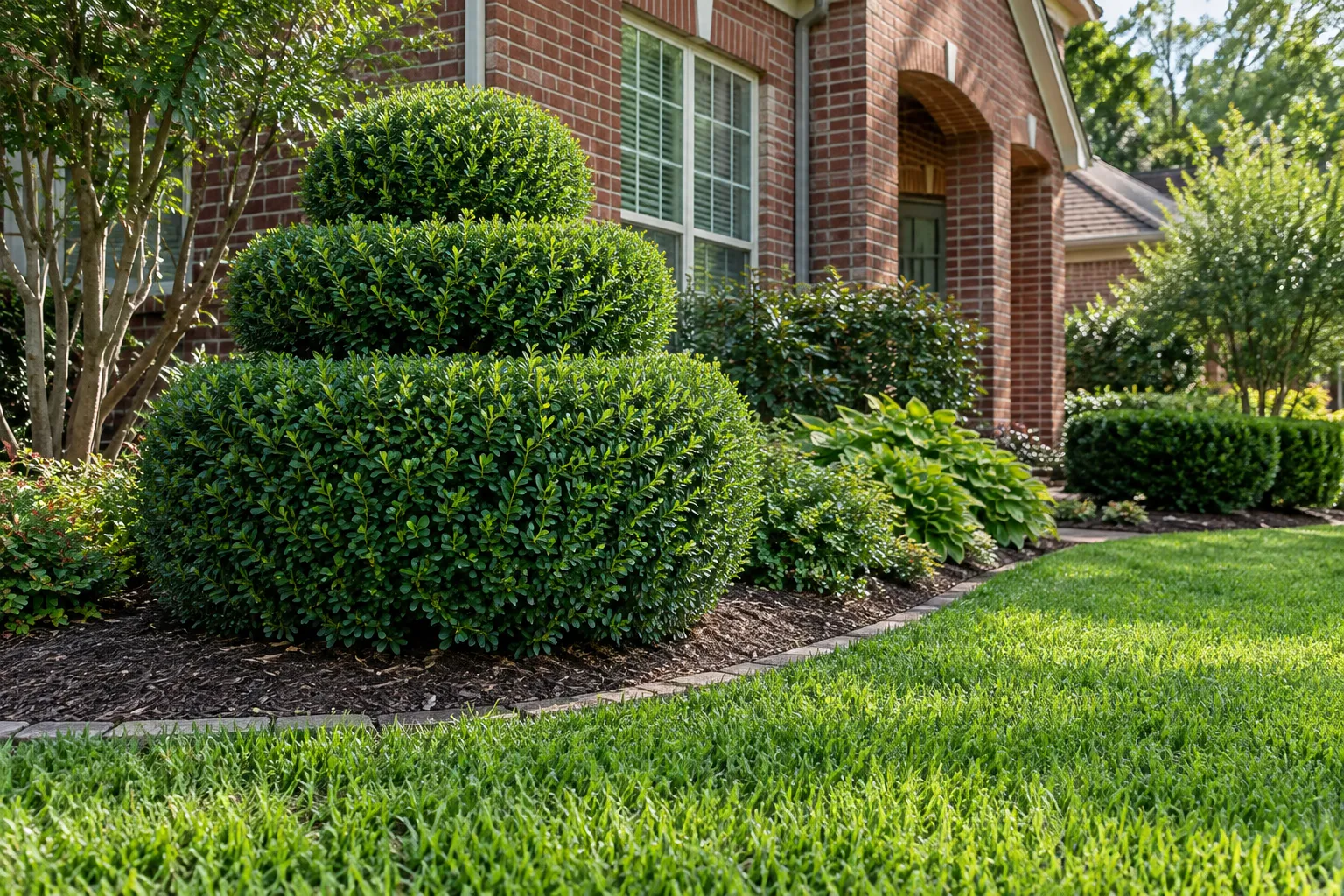
Boxwood Topiary Planting & Care in Conroe & Houston
Boxwood topiary combines a living shrub with a maintained geometric form.
Family-owned since 2010 · Own crews · Licensed & insured · Free written estimates
Boxwood Topiary planting and care requirements
The species and cultivar determine heat tolerance and eventual growth, while clipping determines the outline. Identify both before installation; common box and more heat-tolerant alternatives should not be treated as identical material under a decorative label.
For boxwood topiary work in Houston, Conroe, Katy or Spring, send Boone’s the address, a few photos of the area and what you want done. Boone’s is based in Montgomery, TX.
Services
What Boone’s handles for Boxwood Topiary. Each is priced after we walk the property.
Boxwood Topiary Planting
Boxwood topiary planting should keep the shallow root system at an appropriate depth and provide adequate drainage. Leave clearance around the finished shape for clipping and inspection. A formal design should not force the plant into a hot confined position without considering the selected species' tolerance.
Boxwood Topiary Nutrition & Fertilization
Boxwood topiary fertilization should be based on vigor and soil findings, not on a wish for ever denser exterior growth. Nutrition cannot substitute for light and air within the shrub. Review watering, clipping intensity and root condition before prescribing more feed to a plant with an unhealthy interior.
Boxwood Topiary Soil Assessment & Soil Replacement
Boxwood topiary soil work should protect shallow roots and avoid planting too deeply. Assess drainage and compaction before replacement. A broad, suitable root environment is more useful than burying the base in a mound of rich material to raise the apparent height of the finished shape.
Boxwood Topiary Sourcing
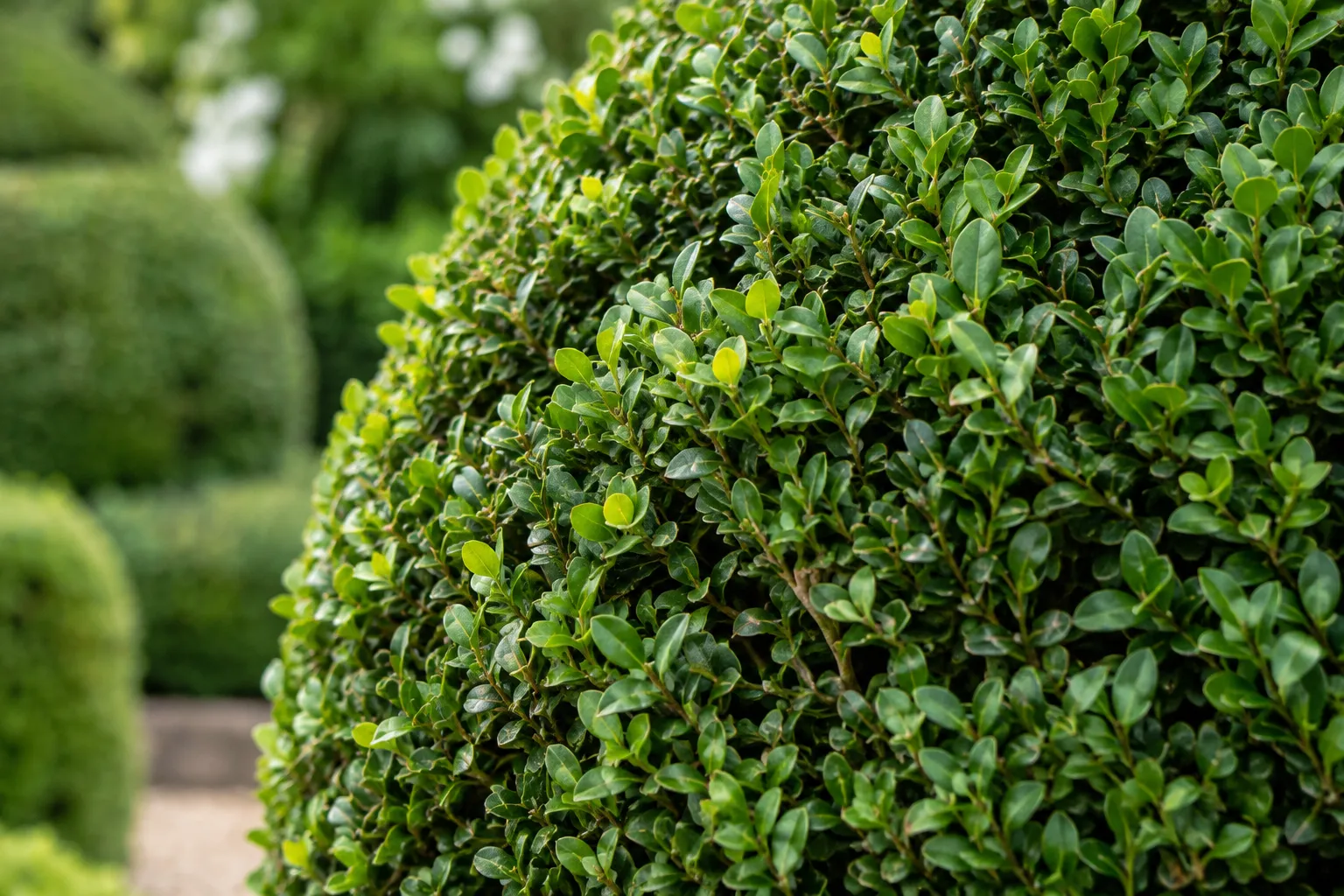
Boxwood topiary sourcing should identify the Buxus species, cultivar and actual trained form. NC State notes that common box is less heat tolerant than Buxus microphylla. Confirm the material rather than selecting only by the outline of a ball, cone or spiral shown in a nursery image.
Boxwood Topiary Irrigation Installation
Boxwood topiary irrigation should wet the root area while allowing it to drain. Dense foliage can hide the soil and faulty emitters. Inspect moisture directly and compare container plants separately from in-ground specimens, rather than assuming all matching shapes can share one unchanging watering interval.
A dense ball can shed overhead spray away from the root ball. Check where water actually lands beneath the canopy and keep the emitter visible enough to inspect without dismantling the topiary.
Boxwood Topiary Root Drainage
Boxwood topiary root drainage should be checked beneath formal containers and enclosed planting beds. Repeated saturation is not solved by clipping the crown or adding feed. Ensure water can escape and examine the medium before selecting a plant-health treatment for a declining specimen.
Boxwood Topiary Transplanting
Boxwood topiary transplanting should retain the root system and protect the existing geometry during handling. Assess the size of the actual plant, not just its clipped outline. Confirm the receiving depth and watering plan before moving a specimen whose value depends on years of shaping.
Boxwood Topiary Aftercare & Maintenance
Boxwood topiary aftercare should monitor the interior as well as the exterior surface. Mulch can help protect shallow roots, but should not bury the base. Keep clipping and moisture records so an attractive outer shell does not conceal increasing shade, poor air movement or root stress inside the planting.
Boxwood Topiary Pruning
Boxwood topiary pruning needs both shaping and selective thinning. The reference recommends thinning for light and air and warns against poorly timed cutting in early spring or late summer. Adapt timing locally rather than imposing a fixed frequent haircut that encourages a dense exterior with a weak interior. Preserve the agreed proportions from more than one viewpoint.
Boxwood Topiary Health Assessment
Boxwood topiary health assessment should examine roots, leaves and the interior branch system. Winter bronzing, heat stress and a diagnosed disease are different concerns. Confirm the species and exposure before treatment; a tightly clipped appearance does not make yellowing an automatic request for more fertilizer.
Talk to Boone’s about Boxwood Topiary
Own crews, licensed and insured, working Conroe, Houston and Montgomery County since 2010.
How it works
How a Boxwood Topiary project starts
- 01
Call or send photos
Call (936) 206-7627 or use the form with the address and a few photos of the area.
- 02
We walk the property
We look at the site, the light, the soil and the access before anything is priced.
- 03
Written estimate
You get a detailed estimate in writing at no cost, and the work is done by our own crews.
Common questions about Boxwood Topiary
Will a purchased topiary retain its shape without maintenance?
No. The shape is the result of repeated training and trimming. The proposal should separate installation from ongoing topiary care and make the required access and responsibilities clear.
How do I choose a boxwood for a hot garden?
Specify the species or cultivar, not only the shape. Boxwoods differ in heat response and mature size. A form that looks dense in the nursery still needs suitable light, root conditions and enough working space to maintain its outline.
Why is the inside of the topiary becoming bare?
Repeated surface shearing can leave a dense outer shell. Inspect the interior, airflow and branch condition before cutting harder. Thinning and outline clipping have different purposes; a bare area should not automatically be treated with more fertilizer.
What should happen before a new topiary joins an existing collection?
Inspect the leaves, stems and root ball and keep its supplier identity. Avoid immediately mixing a questionable specimen into a row of healthy plants. Review any dieback before sharing clipping tools across the collection or discarding its original labels.
Related plants and projects
Japanese Black Pine
Japanese black pine is a character tree with paired needles and an increasingly irregular crown.
Niwaki Pine
Niwaki describes a trained garden tree, not a botanical species.
Shimpaku Juniper
Shimpaku juniper is sought for fine evergreen foliage and a sculptural framework.
Tree Planting
Tree planting should match the actual tree to a place where it can develop.
Tree Health Assessment
A tree health assessment investigates symptoms before choosing treatment.
Get a free estimate for Boxwood Topiary
Call (936) 206-7627 or send the address and a few photos through the form. We walk the property and put the price in writing at no cost.