

Italian Cypress Care, Pruning & Planting in Conroe & Houston
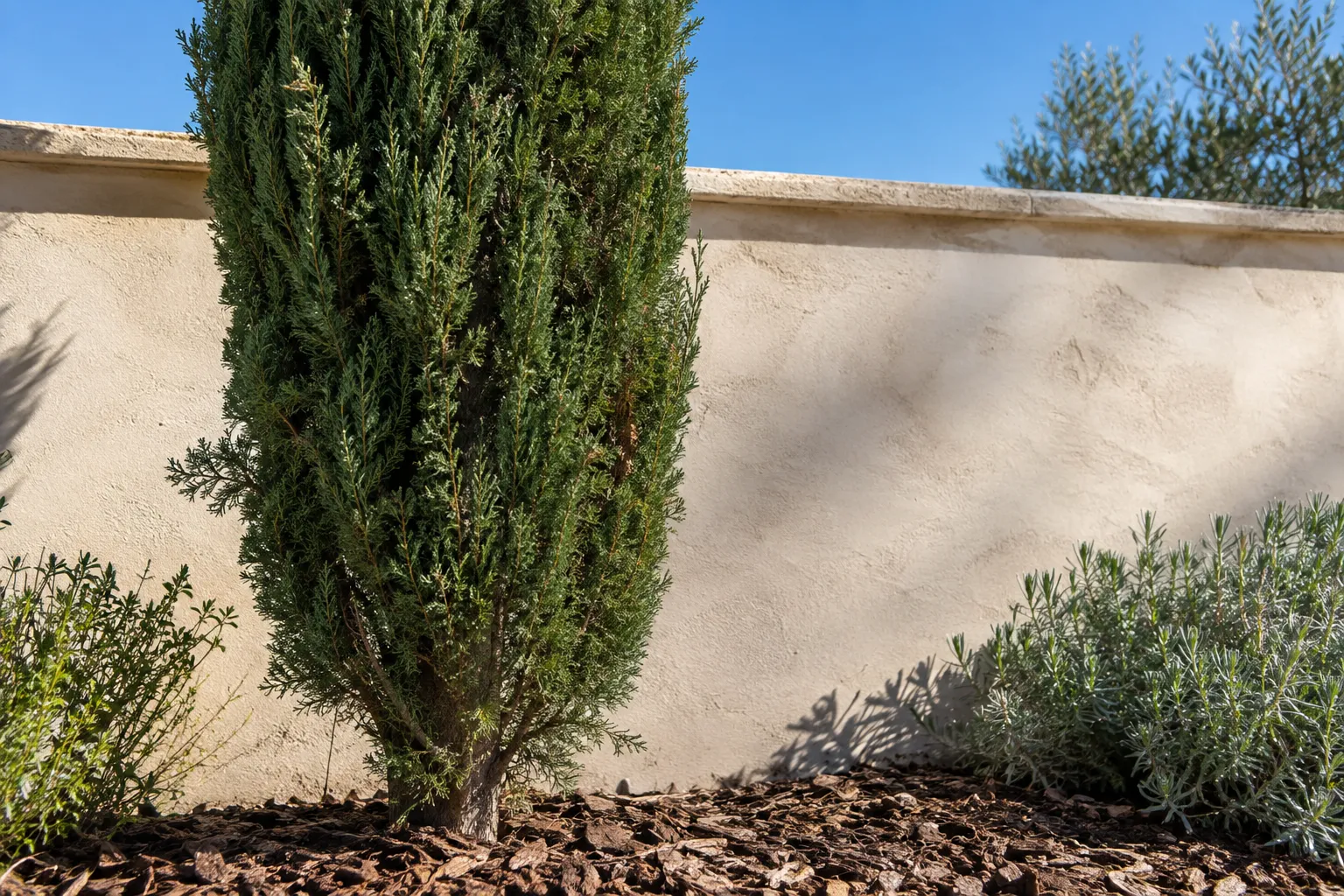
Italian cypress is chosen for vertical form.
Family-owned since 2010 · Own crews · Licensed & insured · Free written estimates
Italian Cypress planting and care requirements
It should not need to be repeatedly reshaped to provide that effect, and a narrow crown should not be confused with an unrestricted fit for any narrow bed. Sun, root drainage and maintenance access need to be established before a formal row is laid out.
For Italian cypress work in Houston, Conroe, Katy or Spring, send Boone’s the address, a few photos of the area and what you want done. Boone’s is based in Montgomery, TX.
Services
What Boone’s handles for Italian Cypress. Each is priced after we walk the property.
Italian Cypress Planting
Italian cypress planting should provide room around the bases of a row and a site with suitable drainage. Judge the future relationship between crowns rather than ordering the maximum number of trees that fit now. A columnar specimen still needs a workable rooting area and access for inspection.
Italian Cypress Nutrition & Fertilization
Italian cypress fertilization should follow a condition assessment, not be used to make a screening row grow at a promised speed. Brown foliage may involve mites, canker or root problems. Check those possibilities and the watering arrangement before interpreting a weak tree as simply short of nutrients.
Italian Cypress Soil Assessment & Soil Replacement
Italian cypress soil work should prioritize an aerated root zone and examine compaction around new construction. The natural association with rocky ground does not mean a gravel-topped clay pocket is suitable. Request evidence for soil replacement rather than accepting it as an automatic accompaniment to every specimen.
Italian Cypress Sourcing
Italian cypress sourcing should confirm Cupressus sempervirens and the selected columnar form. Compare actual specimens for habit and root condition. A nursery row that looks uniform from a distance can still contain differences worth resolving before it becomes a formal architectural planting.
Italian Cypress Irrigation Installation
Italian cypress irrigation should supply adequate water while young trees establish, then adapt to their response. Later drought tolerance does not excuse a dry new root ball. Inspect each tree in a row: one faulty emitter can create a conspicuous gap even when the rest of the planting receives enough water.
Italian Cypress Root Drainage
Italian cypress root drainage needs particular care because the source identifies root rot in poorly drained locations. Check ponding along foundations and behind edging before installation. A persistent wet patch should be corrected rather than masked with new mulch or a stronger fertilizer program.
Observe the strip after both rainfall and an irrigation cycle. Water entering from paving can keep a small planting opening wet even when the neighboring bed looks dry; fixing that route is more useful than changing mulch alone.
Italian Cypress Transplanting
Italian cypress transplanting needs the root ball and tall crown supported together. The reference discusses moving during periods of root activity, but its calendar should not be copied as a universal Texas schedule. Have the actual tree, weather and access assessed before committing to a move.
Italian Cypress Aftercare & Maintenance
Italian cypress aftercare should compare the whole row, looking for changes in color or growth on individual trees. Inspect irrigation output and the ground around the affected base. Keep maintenance equipment from injuring stems, and avoid routine interventions simply to satisfy a fixed service calendar.
Italian Cypress Pruning
Italian cypress pruning is generally unnecessary to preserve its natural columnar habit. Do not sell repeated topping as essential care for a correctly chosen specimen. Remove or assess damaged material as needed, and reconsider plant selection where the available space would require ongoing severe size control.
Italian Cypress Health Assessment
Italian cypress health assessment should consider mites, bagworms, canker and root rot among possible explanations for decline. None can be confirmed from distant brown foliage alone. Inspect the pattern of damage and drainage before choosing treatment, especially where only part of a formal row is affected.
Talk to Boone’s about Italian Cypress
Own crews, licensed and insured, working Conroe, Houston and Montgomery County since 2010.
How it works
How a Italian Cypress project starts
- 01
Call or send photos
Call (936) 206-7627 or use the form with the address and a few photos of the area.
- 02
We walk the property
We look at the site, the light, the soil and the access before anything is priced.
- 03
Written estimate
You get a detailed estimate in writing at no cost, and the work is done by our own crews.
Common questions about Italian Cypress
Can Italian cypress fit any narrow bed?
No. Narrow foliage does not mean negligible root space, unlimited height clearance or tolerance of stagnant soil. Compare the available rooting area and overhead space with the actual selection before approving a row.
Should Italian cypress be topped to make a shorter column?
Do not choose a tall columnar tree on the assumption that topping will preserve its natural outline. Match the selection to the available height. If a low screen is required, consider a different planting instead of making severe reduction the routine plan.
Why can a thin brown strip in the crown need investigation?
Inspect foliage, branches and root moisture rather than assuming a single cause. Mites, canker and root problems are among the possibilities described for the species. The pattern and progression of damage matter more than a diagnosis from one distant photograph.
Is a narrow strip beside a driveway always suitable?
No. Check rooting room, overhead space and runoff, including water directed off the drive. The visible column may fit while the receiving ground stays saturated. Place the tree for its long-term requirements rather than the nursery crown's present width.
Related plants and projects
Japanese Black Pine
Japanese black pine is a character tree with paired needles and an increasingly irregular crown.
Niwaki Pine
Niwaki describes a trained garden tree, not a botanical species.
Shimpaku Juniper
Shimpaku juniper is sought for fine evergreen foliage and a sculptural framework.
Tree Planting
Tree planting should match the actual tree to a place where it can develop.
Tree Health Assessment
A tree health assessment investigates symptoms before choosing treatment.
Get a free estimate for Italian Cypress
Call (936) 206-7627 or send the address and a few photos through the form. We walk the property and put the price in writing at no cost.
Sources
- Plant reference: Cupressus sempervirens
- ISA TreesAreGood — tree planting principles
- UNH Extension — when trees and shrubs need fertilizer
- US EPA WaterSense — irrigation management
- LSU AgCenter — moving established trees and shrubs within the landscape
- The Morton Arboretum — evergreen tree and shrub pruning