
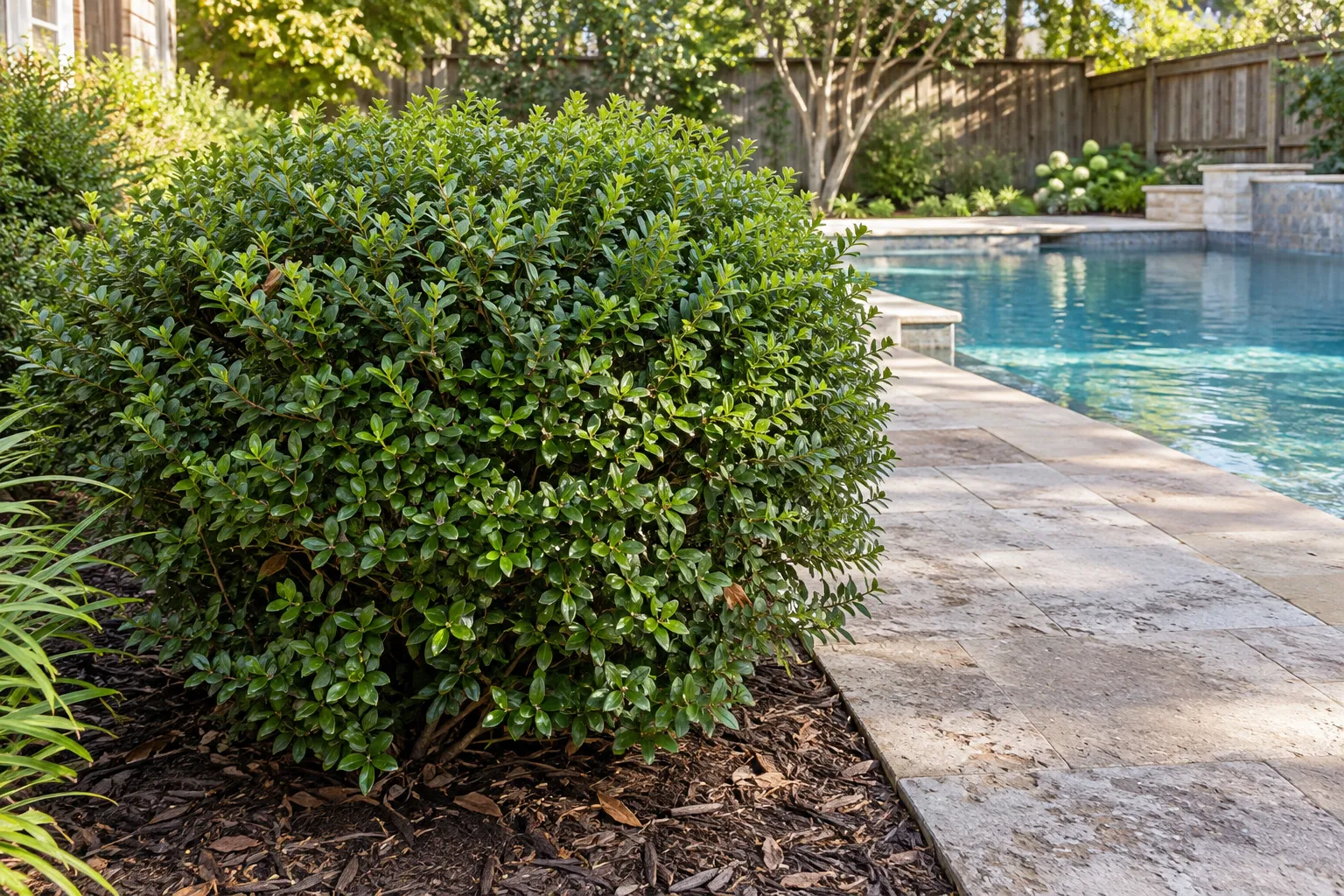
Japanese Holly Care, Pruning & Planting in Conroe & Houston
Japanese holly provides small evergreen leaves and a compact outline, but it should not be selected on appearance alone.
Family-owned since 2010 · Own crews · Licensed & insured · Free written estimates
Japanese Holly planting and care requirements
The species reference warns that high heat and humidity can limit performance in the southern United States. Site suitability therefore needs a clear discussion before a formal hedge is ordered.
For Japanese holly work in Houston, Conroe, Katy or Spring, send Boone’s the address, a few photos of the area and what you want done. Boone’s is based in Montgomery, TX.
Services
What Boone’s handles for Japanese Holly. Each is priced after we walk the property.
Japanese Holly Planting
Japanese holly planting requires acidic, well-drained ground and enough room for the chosen cultivar. Full sun or partial shade may be appropriate, but regional heat and humidity remain constraints. A visually tidy nursery plant is not evidence that the proposed exposed site will suit it.
Check the planting position during the hottest part of its daily exposure. A shaded nursery display can conceal the stress a formal hedge will face beside a reflective wall, so make that comparison before delivery.
Japanese Holly Nutrition & Fertilization
Japanese holly fertilization should be based on its condition and soil reaction. Feeding cannot remove the heat-and-humidity concern documented for this species. Before adding nutrition inputs to a weak hedge, examine drainage, planting depth and whether the cultivar is appropriate for the location.
Japanese Holly Transplanting
Japanese holly transplanting is described favorably at species level, yet an old clipped hedge still requires a root and condition assessment. Measure the available root ball and receiving bed. Ease of moving nursery stock should not be used as a survival guarantee for established plants.
Japanese Holly Soil Assessment & Soil Replacement
Japanese holly soil work should address acidity and drainage across the future hedge, not just each individual hole. Tolerance of clay texture does not mean a waterlogged bed is suitable. Obtain soil information before prescribing replacement or chemical adjustment as a universal installation package.
Japanese Holly Sourcing
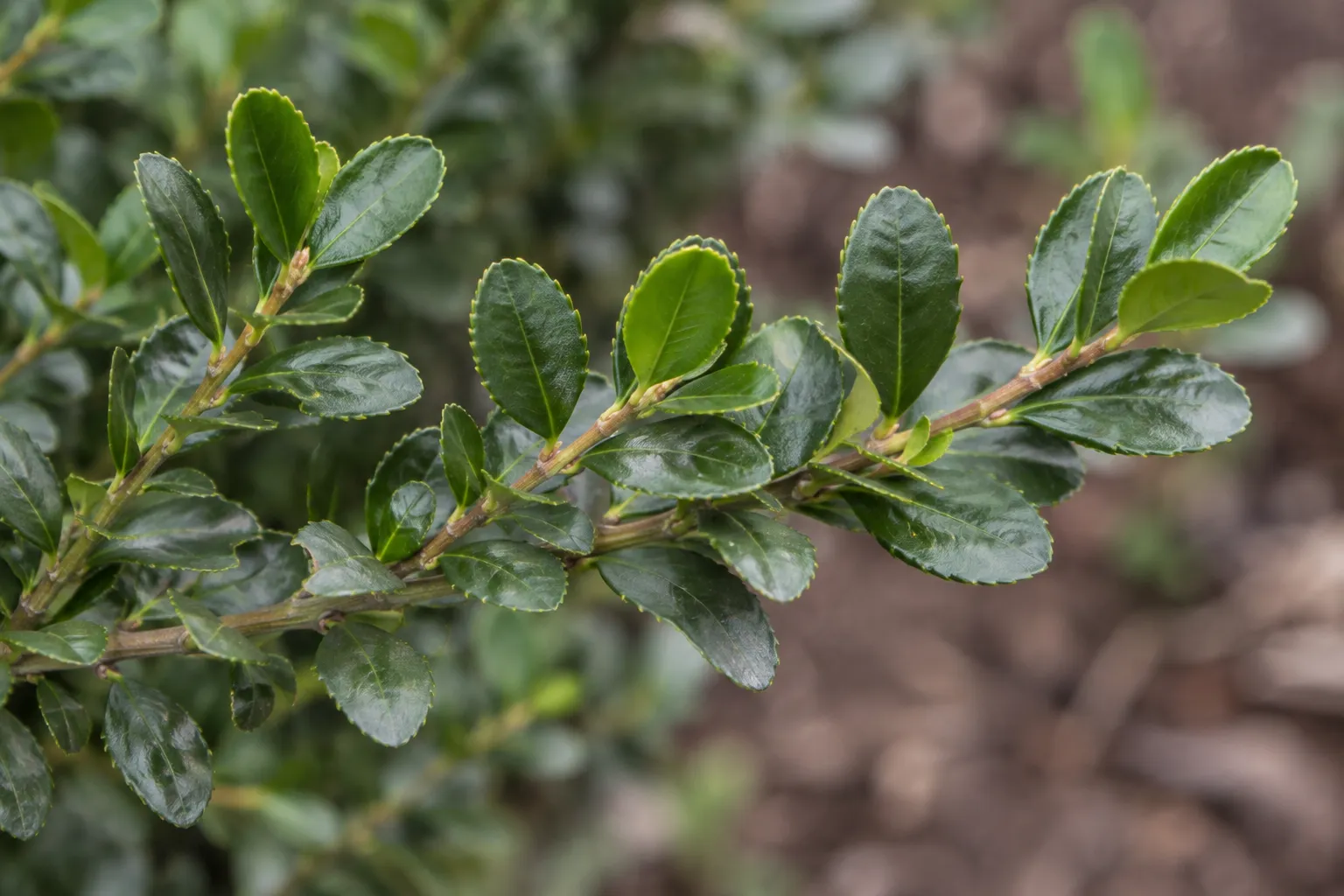
Japanese holly sourcing should specify the cultivar rather than Ilex crenata alone. Compact and more upright selections differ in final width. If fruit matters, confirm plant sex and pollination requirements; do not promise berries simply because the nursery photograph shows them on another specimen.
Japanese Holly Irrigation Installation
Japanese holly irrigation should distinguish root-ball establishment from routine watering of adjacent plants. Dense clipped foliage can conceal failures, so inspect delivery directly. A separate adjustment is useful where the shaded end of a hedge remains wet longer than its sun-exposed end.
Japanese Holly Root Drainage
Japanese holly root drainage should be tested where a formal bed meets paths or foundations. Water can accumulate behind edging even when the intended geometry is correct. Resolve the trapped flow before planting; the visual symmetry of a hedge does not make its subsurface conditions uniform.
Japanese Holly Aftercare & Maintenance
Japanese holly aftercare should check density, root moisture and the response to summer conditions before expanding the planting. Retain the cultivar record so declining specimens are not repeatedly replaced with the same unsuitable choice. A planting that needs constant rescue may call for a different species rather than more inputs.
Japanese Holly Pruning
Japanese holly pruning can maintain formal shapes, but repeated shearing is a maintenance commitment. Select the cultivar for its eventual size and agree the desired form. Avoid treating the plant's ability to tolerate pruning as a reason to place it where it must always be drastically reduced.
Balance the desired surface with light and access through the canopy. The objective is a healthy screen in the correct space, not simply the smallest outline that can be forced around an inconvenient bed.
Japanese Holly Health Assessment
Japanese holly health assessment must include environmental suitability. Inspect the affected portions, soil moisture and roots before assigning a pathogen or deficiency. The documented difficulty in hot, humid southern settings means that a species-level mismatch should remain part of the diagnosis, not be omitted from the sales discussion.
Talk to Boone’s about Japanese Holly
Own crews, licensed and insured, working Conroe, Houston and Montgomery County since 2010.
How it works
How a Japanese Holly project starts
- 01
Call or send photos
Call (936) 206-7627 or use the form with the address and a few photos of the area.
- 02
We walk the property
We look at the site, the light, the soil and the access before anything is priced.
- 03
Written estimate
You get a detailed estimate in writing at no cost, and the work is done by our own crews.
Common questions about Japanese Holly
Is Japanese holly interchangeable with yaupon holly?
No. They are different species with different tolerances and forms. A similar small-leaf appearance does not establish equivalent site performance. The planting decision should compare the actual cultivar and conditions, not the word holly alone.
Why compare Japanese holly with other local screen plants first?
Ilex crenata can struggle in high heat and humidity despite its attractive small leaves. Evaluate the actual cultivar and exposure before committing to a large row. A similarly shaped holly may have different tolerances, so replacement choices need more than a visual match.
Can alkaline soil be corrected by repeatedly feeding the hedge?
Not reliably. Review soil reaction, moisture and root health before using fertilizer. A recurring leaf-color problem can reflect unsuitable growing conditions rather than a simple shortage, and concentrated feeding does not permanently alter the whole rooting environment.
Will any Japanese holly produce the desired berries?
Fruit depends on the plant's sex and suitable pollination, as well as growing conditions. Where fruit is part of the design, document those requirements. Do not sell a clipped row solely from a photograph of a fruiting specimen of another selection.
Related plants and projects
Japanese Black Pine
Japanese black pine is a character tree with paired needles and an increasingly irregular crown.
Niwaki Pine
Niwaki describes a trained garden tree, not a botanical species.
Shimpaku Juniper
Shimpaku juniper is sought for fine evergreen foliage and a sculptural framework.
Tree Planting
Tree planting should match the actual tree to a place where it can develop.
Tree Health Assessment
A tree health assessment investigates symptoms before choosing treatment.
Get a free estimate for Japanese Holly
Call (936) 206-7627 or send the address and a few photos through the form. We walk the property and put the price in writing at no cost.